UCSC track hubs
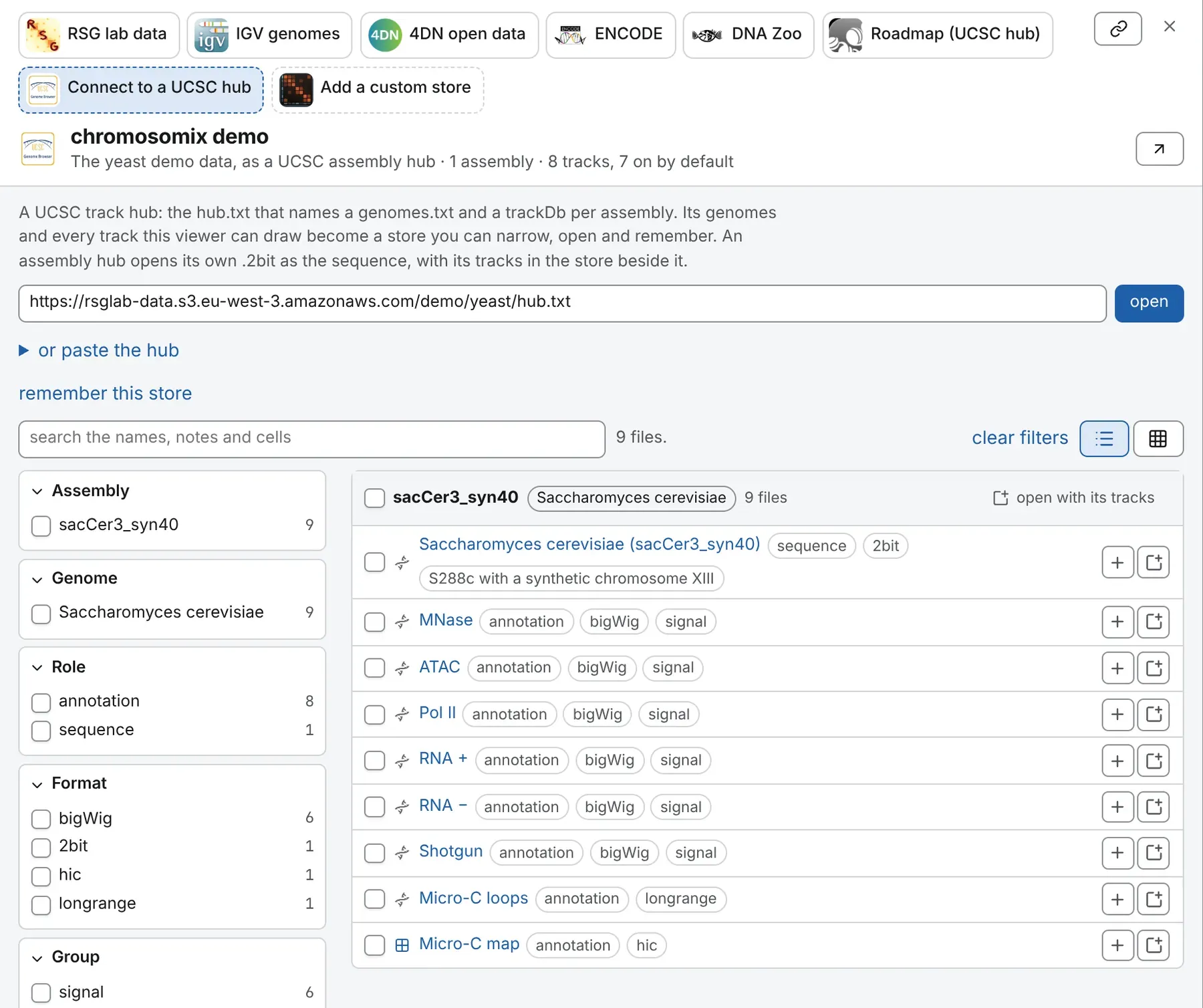
chromosomix opens a UCSC track hub as a data store, with its genomes and tracks as rows.
Connecting a hub
Section titled “Connecting a hub”- On the landing page, under Connect to a data store, press Connect to a UCSC hub, or the same tile at the head of the store drawer.
- Paste the address of the hub’s
hub.txtand press open.
The hub’s text files are read at once; no track is read until you open it.
- A link to it is
https://chromosomix.app/?store=<address of hub.txt>; the drawer’s link button copies one, narrowed as the page is. - remember this store keeps it as a tile in this browser; forget this store on its page removes the tile.
- Either door works. A hub is told by its first stanza, so it also opens from Add a custom store, and from an address not ending in
hub.txt. - A hub on a private bucket is read with the bucket key that covers it.
On this door, the arrow at the head of the drawer goes to UCSC’s list of public hubs.
What is read
Section titled “What is read”| File | What chromosomix reads |
|---|---|
hub.txt |
hub, shortLabel (the store’s name), longLabel (the start of its description), genomesFile, useOneFile |
genomes.txt |
each genome stanza: genome, trackDb, twoBitPath, chromSizes, and organism or description as the genome’s name |
trackDb.txt |
each track stanza: type, bigDataUrl, bigDataIndex, shortLabel (the row’s name), longLabel (its note), parent or superTrack, visibility; and every include line, followed |
- One file or three. With
useOneFile on, the stanzas are inhub.txtitself, and a track belongs to thegenomestanza it follows. - Each name is read against the file that wrote it: a
bigDataUrlagainst itstrackDb.txt, atwoBitPathagainstgenomes.txt. - The stanza format is UCSC’s. Indentation means nothing — a track nests by its
parentline — and atrackline starts a new stanza even without a blank line before it. - Display settings are not carried over: tracks open with this viewer’s own colours, heights and limits.
- A hub is read in at most 64 files, following
includelines up to four files deep, so a very large hub may come in part.
What a hub becomes
Section titled “What a hub becomes”A row per genome and per track that can be drawn, grouped by assembly, with the columns Assembly, Genome, Role (sequence or annotation), Format and Group: the composite or super-track a track is filed under, usually the facet to narrow by.
The genome row, which the browser opens a genome on, is:
- an assembly hub’s own
.2bit(twoBitPath); - for a hub on an assembly UCSC hosts (
genome hg38), itschromSizesfile, or else its firstbig…track, whose header lists every sequence; the row’s note says which; - none, for a hub with neither: chromosomix does not fetch a sequence the hub did not name.
open with its tracks, on an assembly’s heading, opens the genome row with the tracks the hub asks to show. Each track also has its own row.
Track types
Section titled “Track types”| Type | Opens as |
|---|---|
bigWig |
a signal track |
bigBed, bigNarrowPeak, bigGenePred, bigPsl, bigChain, bigMaf, bigLolly, bigDbSnp, bigRmsk |
a bigBed track |
bigBarChart, barChart |
a bar chart |
bigInteract, interact, longTabix |
interactions, drawn as arcs |
bigMethyl, bedMethyl |
methylation |
vcfTabix |
variants |
bam |
reads |
hic |
a contact map |
A hic track opens as a map, from its own row; open with its tracks leaves it out. An index named by bigDataIndex is read there, otherwise beside the file.
Tracks a hub switches off
Section titled “Tracks a hub switches off”As at UCSC, a track with visibility hide, a subtrack with parent <name> off, and every subtrack of a hidden composite are off: open with its tracks leaves them out, but they keep their rows. The store’s description counts both (440 tracks, 20 on by default).
What is left out
Section titled “What is left out”A track this viewer cannot draw gets no row; the store’s description counts them, with the reason:
cram, which needs the exact reference its reads were compressed against: convert it to BAM withsamtools view -b.halSnake, drawn by a server, with no file to read.- a stanza with no
type, or a type with no reader here.
Composites, super-tracks and views are headings, not rows: their names fill the Group column.
Hubs on UCSC’s own servers
Section titled “Hubs on UCSC’s own servers”As of September 2026, genome.ucsc.edu and hgdownload.soe.ucsc.edu do not let other sites read them, so no browser-only viewer can open UCSC’s example hubs or GenArk, and chromosomix says so. Pasting such a hub’s text gets past its hub.txt, not its data files. Copy the hub and its files to a host that does (Hosting your data), or drop a downloaded track or two on the window. A connected folder lists a hub.txt but does not open it as a hub.
Pasting a hub
Section titled “Pasting a hub”When a hub’s host will not answer, or while you write one, open or paste the hub under the address box. Paste a one-file hub, or hub.txt, genomes.txt and trackDb.txt one after another, give the base address of relative names in the box under it, and press open what is pasted. A hub.txt alone is refused, with a note naming the file to add. A pasted hub is not remembered, nor linked.
fill in an example puts this working hub, over the yeast demo data, in the box:
hub exampleHubshortLabel Example hublongLabel Yeast demo data from RSG labuseOneFile on
genome R64-1-1organism Saccharomyces cerevisiaetwoBitPath https://rsglab-data.s3.eu-west-3.amazonaws.com/demo/store/yeast/S288c.2bit
track signalcompositeTrack onshortLabel SignallongLabel Two tracks, grouped as their hub groups themtype bigWig
    track mnase    parent signal on    shortLabel MNase    longLabel Nucleosome occupancy    bigDataUrl https://rsglab-data.s3.eu-west-3.amazonaws.com/demo/store/yeast/Yeast_MNase.bw    type bigWig
    track atac    parent signal on    shortLabel ATAC    longLabel ATAC-seq accessibility    bigDataUrl https://rsglab-data.s3.eu-west-3.amazonaws.com/demo/store/yeast/Yeast_ATAC.bw    type bigWig
track contactsshortLabel Micro-C maplongLabel A contact map, which opens through the map doorbigDataUrl https://rsglab-data.s3.eu-west-3.amazonaws.com/demo/store/yeast/GSE151553_A364_merged.hictype hic
Its genome row is the yeast .2bit; open with its tracks adds the Signal composite’s two bigWigs; the Micro-C map has its own row.
Roadmap, a hub that ships with the viewer
Section titled “Roadmap, a hub that ships with the viewer”Roadmap (UCSC hub), a built-in store, is WashU’s hub of the Roadmap Epigenomics integrative tracks (https://vizhub.wustl.edu/VizHub/RoadmapIntegrative.txt), read from WashU when you open it, and linked as https://chromosomix.app/?store=roadmap. The arrow at the head of its page goes to Roadmap’s WashU portal.
Publishing a hub of your own
Section titled “Publishing a hub of your own”Publish a hub like a data store, with its data on a host that serves byte ranges (Hosting your data). For UCSC’s browser too, keep to the formats UCSC takes in a hub — the big… formats, bam, cram, vcfTabix, hic, longTabix — so a BED or narrowPeak goes in as a bigBed. For chromosomix alone, a store file also takes your own columns, sizes and saved sessions.
Documentation of chromosomix v0.20.0 · built from 40ec1ec · source