
Diamond insulation
- In the app
- Analysis panel, under 2D tasks: Diamond insulation
- Command
chromosomix insulation- Reads
- A contact map
- Also known as
- TAD, domains, boundaries, insulation score
Diamond insulation scores how much contact crosses each bin. A square window slides along the diagonal; where a domain boundary sits, little contact passes from one side to the other, and the score dips. You get the boundaries as a track, as calls and as the domains between them, at one scale or several. The directionality index, the HiC score and TAD annotation read domains in other ways.
Running it
Section titled “Running it”In the Analysis panel (4), choose Diamond insulation, tick the sequences (all are ticked to begin with), set the window, and press run. Three rows land in the Tracks card of the Annotations panel, marked *:
- the score, named after its window: Insulation · 100 kb for the default 10 bins on a 10 kb map;
- Insulation boundaries, one-bin segments beside it, level with their dips;
- Insulation domains, drawn on the map as the corner of each domain’s square.
A called set’s display moves it between a 1D track and a map overlay; on the map, boundaries can be a point or a short diagonal marker.
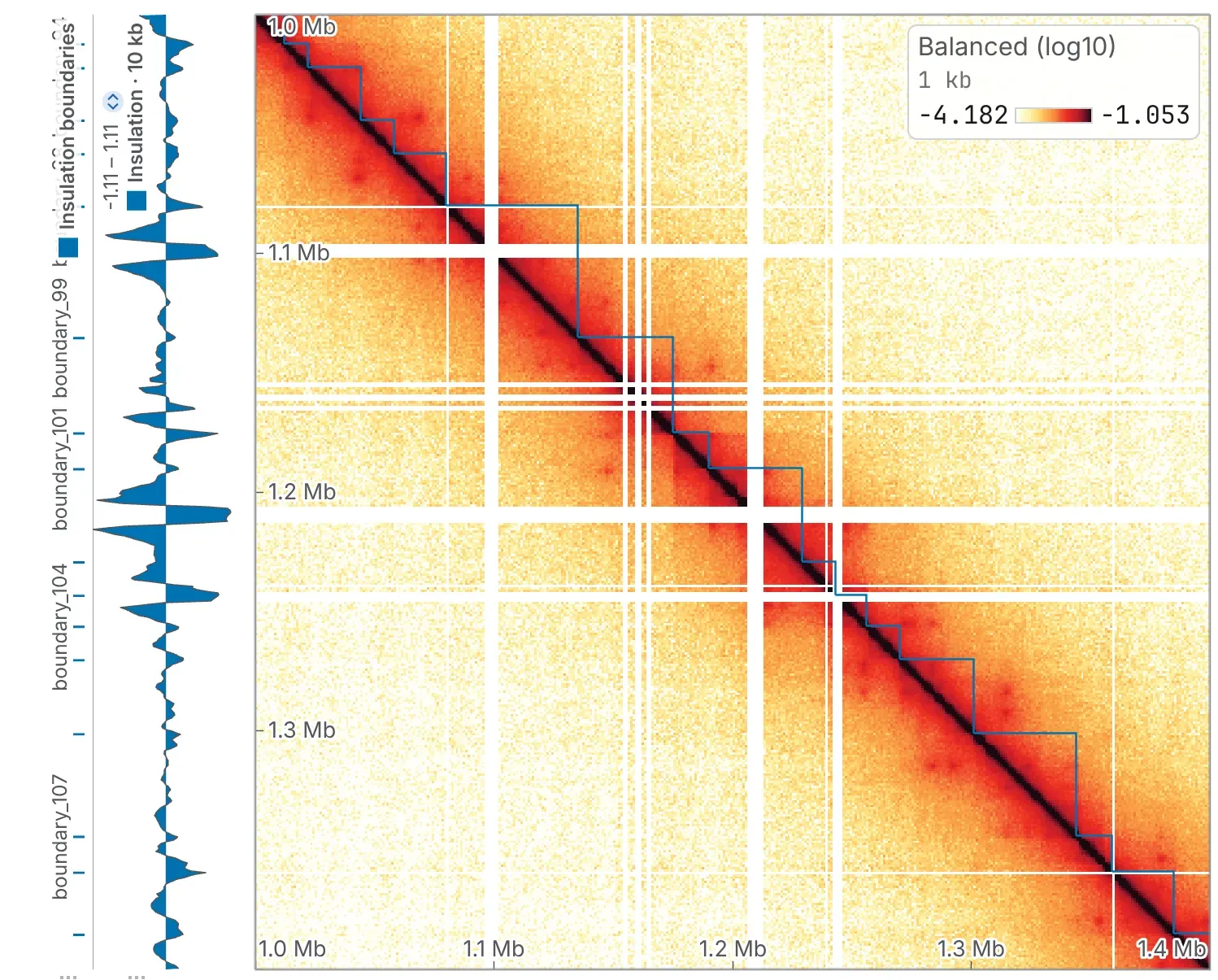
The same run from a shell:
chromosomix insulation <map> [--<parameter> <value> …] --out <dir>For example, four scales from a 10-bin window on the 10 kb rung of an .mcool:
chromosomix insulation sample.mcool::/resolutions/10000 --window 10 --scales 4 --out results/writes the scores sample.insulation.insulation-w10 to sample.insulation.insulation-w80 and the calls sample.insulation.insulation-boundaries and sample.insulation.insulation-domains.
Parameters
Section titled “Parameters”The window is the scale the score is read at, in bins, so its length changes with the resolution. Minimum prominence is how deep a dip must be to count as a boundary. Scales adds wider windows, each twice the last; the calls are always made on the first.
| Parameter | Takes | Default | What it does |
|---|---|---|---|
| General | |||
window--window <n> | a whole number, at least 1, in bins | 10 | The diamond is a square this many bins on a side, cornered on the bin it scores. |
scales--scales <n> | a whole number, 1 to 4 | 1 | One track per scale, each twice the width of the last. |
sequences--sequences <name,…> | sequence names, comma-separated | Every sequence of the file when left out. | — |
use balancing weights--no-balance | a switch | On wherever the file carries balancing weights; --no-balance reads the raw counts. | — |
| Quality | |||
diagonals to ignore--ignoreDiags <n> | a whole number, at least 0 | 2 | 0 counts every cell; 2 leaves out the corner of the diamond on the diagonal. |
| Boundaries | |||
call boundaries--call / --no-call | on or off | on | Adds the calls as a set of their own, a 1D track under the score to begin with. |
minimum prominence--prominence <n> | a number, 0 to 3 | 0.2 | How far the track must climb from a minimum before it falls lower, in log2 units. |
diamond coverage to call--minValid <n> | a number, 0 to 1 | 0.5 | Bins whose diamond holds less than this share of the fullest one’s cells are not called. |
minimum spacing--spacing <n> | a whole number, at least 0, in bins | 0 | Two calls closer than this many bins keep only the stronger. |
domains between them--domains / --no-domains | on or off | on | A second set, the span from each call to the next, drawn as corners along the diagonal to begin with. |
What it writes
Section titled “What it writes”- profile: a value per bin: TSV, bedGraph and bigWig
- intervals: a set of intervals: TSV, and BED (or BEDPE for pairs, or bed3d and PDB for a 3D model)
On the command line every file goes into --out as <file stem>.insulation.<output>.<ext>, and each TSV opens with # lines naming the build, the file and every parameter that produced it.
Reading the result
Section titled “Reading the result”The score
Section titled “The score”A bin’s diamond is the window × window square cornered on its pixel on the diagonal, less the diagonals diagonals to ignore leaves out. Its score is the diamond’s mean over the median of those means along the sequence, in log2: 0 is a typical bin, a negative score means less contact crosses it than usual, and boundaries are the dips. Being relative to each sequence’s median, the score does not grow with sequencing depth, and compares between chromosomes.
The diamond never crosses into the next sequence. At a sequence’s ends and beside bins the balancer dropped, it averages the cells it has, so those bins are scored on fewer cells. A bin whose diamond holds no value, or only zeros, is a gap in the track, never a trough.
With several scales, the score is one lane of heatmaps, widest on top: 10, 20, 40 and 80 bins for a window of 10 and four scales. A boundary that survives every scale is a stripe through the stack. Break the lane up, or draw a row as a line, from its settings.
The boundaries
Section titled “The boundaries”A boundary is a local minimum whose prominence, how far the track climbs from it before falling lower, reaches minimum prominence, in log2 units. Minima count only where the diamond holds at least diamond coverage to call of the fullest diamond’s cells, so sequence ends and unmappable stretches do not call boundaries from a handful of cells. Minimum spacing keeps the stronger of two calls closer than that many bins.
Boundaries are named boundary_1, boundary_2, … in genomic order and scored by their prominence, the column to rank or filter by. If none reaches the threshold, the drawer says so: lower the prominence, or widen the window.
The domains
Section titled “The domains”With domains between them on, each two consecutive boundaries on a sequence make a domain, domain_1, domain_2, …, scored by the weaker of the two. Nothing runs from a sequence’s end to its first boundary. Pile the domains up with aggregate peak analysis as a scaled feature set, or set them against loops and peaks in interval set overlap.
What to watch for
Section titled “What to watch for”- The near-diagonal. The diamond’s corner sits on the diagonal, where self-ligation and unligated fragments land, and at a small window it can dominate the mean. Diagonals to ignore at 2, cooltools’ default, leaves it out; 0 counts every cell. Ignoring as many diagonals as the diamond spans leaves it empty, and the run refuses.
- Circular sequences. A sequence ticked circular in the Chromosomes table is read round its junction, so its end bins get whole diamonds, but the domain spanning the junction is never reported.
- Comparing maps. On a deck, run on all N maps gives a track per map, drawn on one axis under all maps (Maps side by side).
Compared with cooltools
Section titled “Compared with cooltools”The score, the cells each diamond counts and the boundaries’ score, cooltools’ boundary_strength, are cooltools.insulation’s: in § 1 of the validation, on a mouse Hi-C map at 10 kb, every bin both tools score agrees within float32 rounding, and § 24 repeats it at four scales. Minimum spacing and the domains are this app’s own, and do not change the score. To compare a cooltools run, give both the same four numbers:
| chromosomix | cooltools |
|---|---|
--window 10 (bins) |
window_bp=[100_000] at 10 kb: the window times the bin size |
--ignoreDiags 2 |
ignore_diags=2 |
--minValid 0.5 |
min_frac_valid_pixels=0.5 |
--prominence 0.2 |
threshold=0.2 |
Documentation of chromosomix v0.20.0 · built from 40ec1ec · source