
Inter-arm alignment
- In the app
- Analysis panel, under 2D tasks: Inter-arm alignment
- Command
chromosomix interarm- Reads
- A contact map
- Also known as
- arms, secondary diagonal, bacteria, SMC, ParB
Where SMC, loaded at parS beside the origin, zips the two arms of a bacterial chromosome together, its map carries a second diagonal through the origin. Inter-arm alignment turns that diagonal into numbers: how strongly the arms are held together, and how far from the origin.
Running it
Section titled “Running it”The arms are read from the origin: in the Chromosomes table, the first step of the breadcrumb (Moving around), tick the sequence’s circular box and type its origin, 1-based, or let Origin and terminus fill it in. Until then the origin is the first base, and the drawer says so.
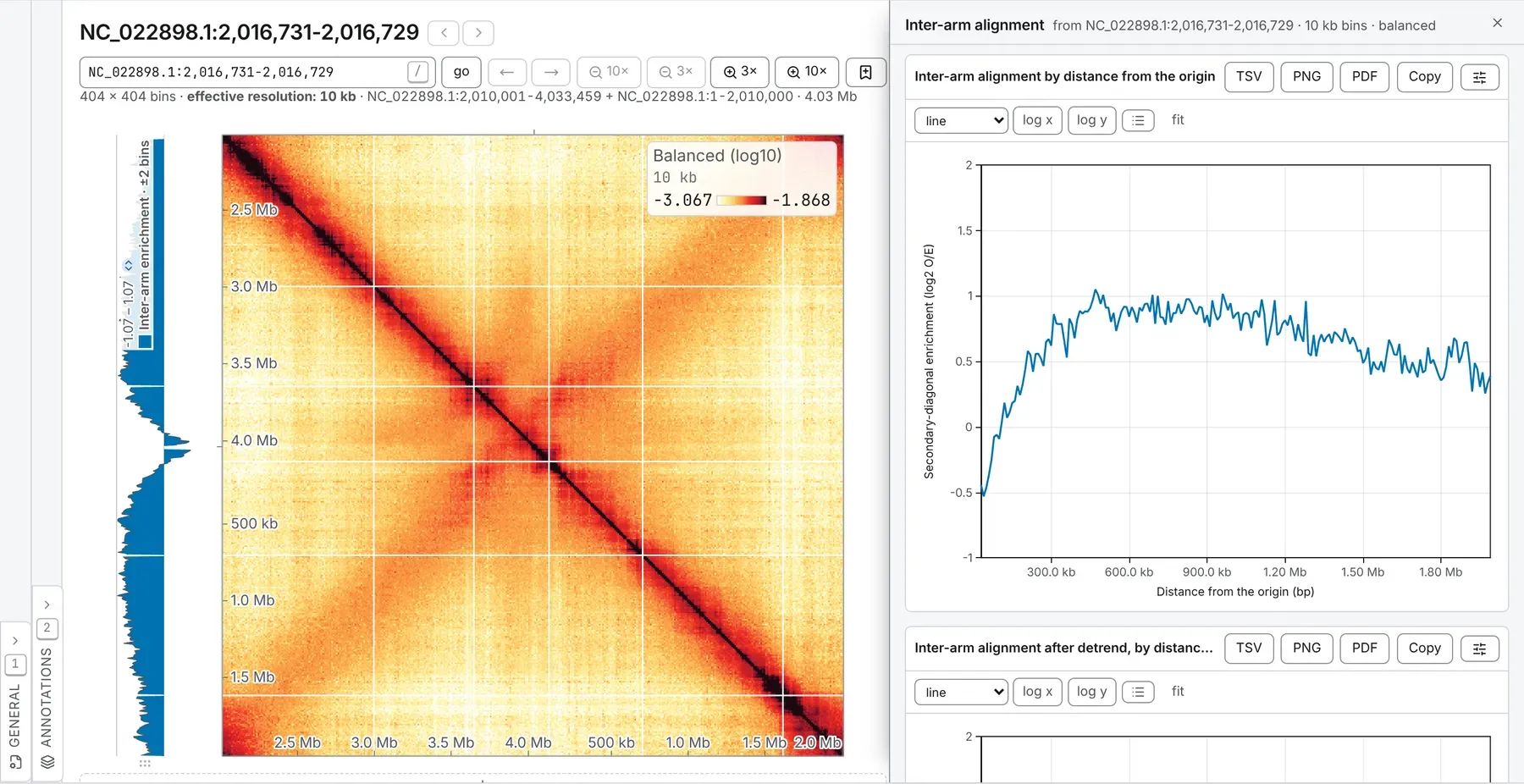
Then choose Inter-arm alignment in the 2D tasks card of the Analysis panel (4) and press run. It makes Inter-arm enrichment, a track marked * on the Tracks card of the Annotations panel: how much each locus touches its mirror image, in log2. The curves and the table below are in the drawer.
The same run from a shell, where --circular and --origin declare what the Chromosomes table holds:
chromosomix interarm <map> [--<parameter> <value> …] --out <dir>chromosomix interarm ecoli.mcool::/resolutions/5000 --circular NC_000913.3 \ --origin NC_000913.3:3925744 --out results/Parameters
Section titled “Parameters”band is how close to the secondary diagonal a cell must be to count, in bins either side; 0 is the diagonal alone. window along the arms is used only by the control, after detrend.
| Parameter | Takes | Default | What it does |
|---|---|---|---|
sequences--sequences <name,…> | sequence names, comma-separated | Every sequence of the file when left out. | — |
band--band <n> | a whole number, 0 to 50, in bins | 2 | Cells this close to the secondary diagonal are averaged; 0 is the diagonal alone. |
window along the arms--armWindow <n> | a whole number, at least 0, in bins | 50 | For the enrichment after detrend: each cell is compared within this far along the arms, as the map’s arms and Compartments do; 0 is the whole chromosome. |
use balancing weights--no-balance | a switch | On wherever the file carries balancing weights; --no-balance reads the raw counts. | — |
What it writes
Section titled “What it writes”- curve: a curve: TSV
- profile: a value per bin: TSV, bedGraph and bigWig
- table: a table: TSV
On the command line every file goes into --out as <file stem>.interarm.<output>.<ext>, and each TSV opens with # lines naming the build, the file and every parameter that produced it.
Reading the result
Section titled “Reading the result”Each cell is divided by the sequence’s own distance decay, and the log2 averaged within band bins of the secondary diagonal by distance from the origin: Inter-arm alignment by distance from the origin, a curve per sequence. Near the origin and the terminus, where the diagonals meet, cells nearer the main diagonal than twice the band and two bins are left out: they measure compaction, not alignment.
On the curve, 0 is no alignment: mirror images touch as often as any two loci as far apart. An aligned chromosome stands above 0 out from the origin, and falls back where the alignment ends. The same after detrend shares its axis. Contact decay along the diagonal and along both arms draws the two decays: along the diagonal, the short way round a circle, for the curve; within and across the arms for the control.
The table
Section titled “The table”Inter-arm alignment per sequence has a row per chromosome:
- read as circular or linear, and the origin used, 1-based.
- enrichment: how many times as often mirror images touch as expected, from the origin out to the reach; 1 is no alignment, 2 twice as often. Where nothing reaches, it is the whole arm’s.
- enrichment after detrend: the same cells over the decay along both arms, which absorbs the secondary diagonal: a control on that detrending, near 1 where it works, not a second measure.
- reach: how far from the origin, in base pairs, the enrichment holds before it falls four-fifths of the way from its peak back to 1 on a log scale, read from a running mean over 2 % of the arm.
- arm: the length of the longer arm.
As a guide, Pseudomonas aeruginosa, whose arms are aligned, reads 3.1 to 3.2 at 2 to 16 kb, reaching about 3.0 Mb of its 3.2 Mb arms, and 0.93 to 0.97 after detrend. E. coli, whose arms are not, reads 1.20 to 1.22: not exactly 1, because the stretch read is wherever its noise runs highest.
What to watch for
Section titled “What to watch for”- Declare the circle. A chromosome read as linear, with its origin near either end, has one arm; the drawer says so.
- Size. A chromosome over 8,192 bins is left out and named: open the file at a coarser resolution. One under 8 bins is left out too.
- Comparing libraries. On a deck, run on all N maps brings the tables together, with a column naming each row’s map (Maps side by side).
Documentation of chromosomix v0.20.0 · built from 40ec1ec · source