
Find a motif
- In the app
- Analysis panel, under 1D tasks: Find a motif
- Command
chromosomix motif- Reads
- Tracks and interval files, with or without a contact map
- Also known as
- sequence, pattern, sites, GATC, restriction
Find a motif finds every match of a motif written in IUPAC letters, such as GGTCANNNTGACC, in a loaded reference, as a set of sites and as a count of sites per bin. Use it for a binding-site consensus, a repeat or a telomere sequence; for where an enzyme cuts, use Restriction sites.
Running it
Section titled “Running it”Load the reference as a FASTA or a .2bit (Reference sequences), open Find a motif on the 1D tasks card of the Analysis panel, choose the reference, type the motif and tick the sequences; no map is needed. A motif the search cannot read is refused, with the reason beside run.
The sites are a track on the Tracks card named after the search, such as GATC (both strands), and the sites per bin a second, the same name followed by density. With no map open there are no bins, so only the sites are made.
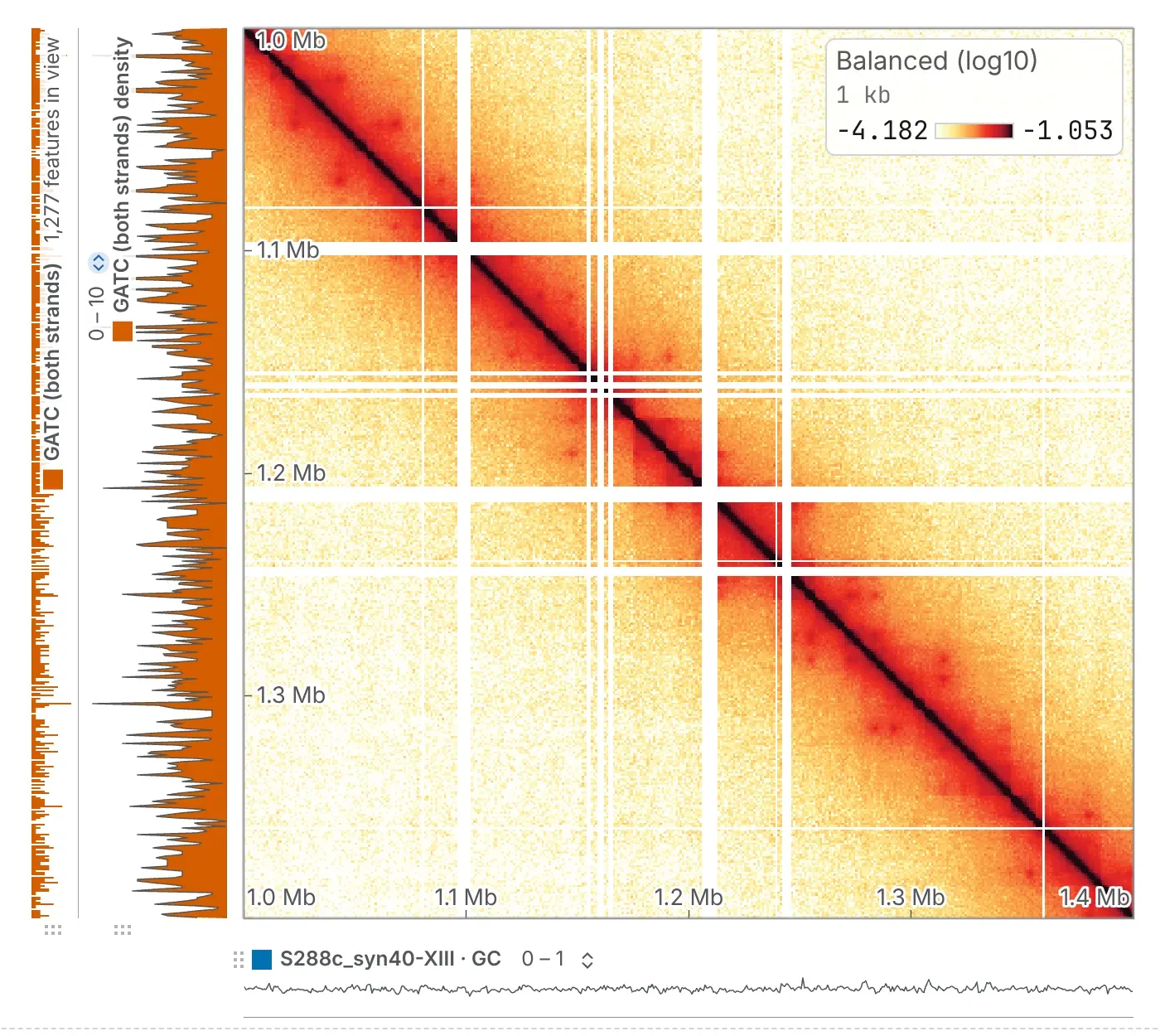
The same run from a shell:
chromosomix motif [<map>] --sequence <sequence.fa> --pattern <pattern> [--<parameter> <value> …] --out <dir>Parameters
Section titled “Parameters”Case and spaces in the motif are ignored, so GGTCA NNN TGACC copied from a paper works as it is, and every overlapping match is counted. both strands is on, since a motif occurs on both strands of the molecule; a palindrome is still reported once. mismatches is for a consensus with variants; leave it at 0 for an exact string such as a telomere repeat. An N in the motif is always free.
| Parameter | Takes | Default | What it does |
|---|---|---|---|
reference--sequence <file> | a file: a reference sequence | — | The FASTA or .2bit to search — its own sequences, in its own order. |
sequences--sequences <name,…> | sequence names, comma-separated | Every sequence of the file when left out. | — |
motif--pattern <text> | text | None. | IUPAC — A C G T U and the ambiguity codes R Y S W K M B D H V N — with spaces and case ignored and every overlapping match counted. |
both strands--bothStrands / --no-bothStrands | on or off | on | A palindrome is still reported once, not twice. |
mismatches--mismatches <n> | a whole number, 0 to 4 | 0 | Positions a site may differ from the motif by; N in the motif is always free. |
most sites--limit <n> | a whole number, 1 to 500000 | 500000 | A backstop against a pattern like N: up to 500,000, and the run says so when it bites. |
What it writes
Section titled “What it writes”- intervals: a set of intervals: TSV, and BED (or BEDPE for pairs, or bed3d and PDB for a 3D model)
- profile: a value per bin: TSV, bedGraph and bigWig
On the command line every file goes into --out as <file stem>.motif.<output>.<ext>, and each TSV opens with # lines naming the build, the file and every parameter that produced it.
Reading the result
Section titled “Reading the result”The sites are one interval per match, as long as the motif, named by the pattern and the strand; a palindrome searched on both strands is one site with no strand. With mismatches allowed, the score column holds how many positions each site differs by: filter on it to keep the exact matches.
The density is the number of sites in each bin, and a bin with no site is a zero, not a gap. Read the density at the scale of a chromosome, and the sites at a few kilobases.
What to watch for
Section titled “What to watch for”- An
Nin the reference never matches a base the motif names, so an assembly gap is not a run of matches. - One run reports at most 500,000 sites; a search that reaches the limit stops and says so. Narrow the motif, or tick fewer sequences.
- Each search is its own pair of tracks: another motif adds rows, and the same search run again updates its own.
Compared with seqkit
Section titled “Compared with seqkit”In the validation, the sites and strands are those of seqkit locate, except that seqkit reports a palindrome twice, once per strand.
Documentation of chromosomix v0.20.0 · built from 40ec1ec · source