Restriction sites
- In the app
- Analysis panel, under 1D tasks: Restriction sites
- Command
chromosomix restriction- Reads
- Tracks and interval files, with or without a contact map
- Also known as
- enzyme, digest, fragments, cut sites, DpnII, MboI, HindIII, Arima
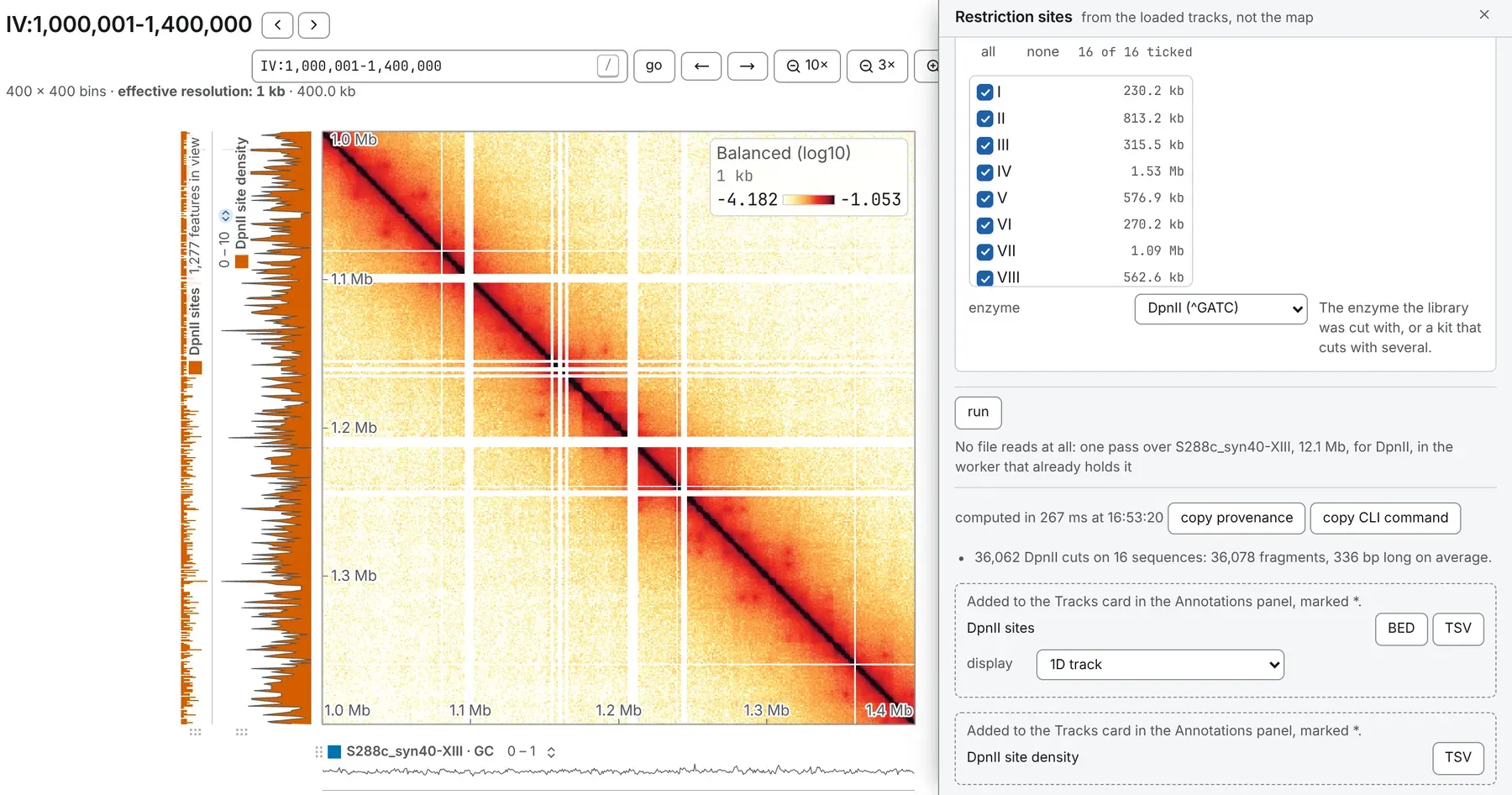
Restriction sites digests the loaded reference with the enzyme or kit a Hi-C library was made with, and lays out every cut as a point, beside the number of cuts in each bin; Pairs QC cuts its fragments with it. Unlike Find a motif with GATC typed in, it places each cut where the enzyme cuts within its site — DpnII before the G of GATC, NlaIII after the G of CATG — so a fragment boundary is the cut, to the base.
Running it
Section titled “Running it”Load the reference as a FASTA or a .2bit, open Restriction sites on the 1D tasks card of the Analysis panel, choose the reference and the enzyme, which starts on none, and tick the sequences. The count per bin needs an open map; without one, only the cuts are made.
The cuts are a track on the Tracks card named after the digest, DpnII sites for DpnII, and the count per bin a second, DpnII site density; a note counts the cuts and the fragments they make.
The same run from a shell:
chromosomix restriction [<map>] --sequence <sequence.fa> [--<parameter> <value> …] --out <dir>Parameters
Section titled “Parameters”enzyme offers the enzymes Hi-C libraries are made with, each shown with its site and where it cuts, such as DpnII ^GATC, which MboI and Sau3AI share, and the Arima kit, which cuts with DpnII and HinfI at once. custom opens sites: enzyme names, aliases such as MboI, or IUPAC sites with a ^ where the top strand is cut, separated by commas, such as G^ANTC, HindIII. A site without its ^, or looser than a four-base cutter, is refused with the reason.
| Parameter | Takes | Default | What it does |
|---|---|---|---|
reference--sequence <file> | a file: a reference sequence | — | The FASTA or .2bit to cut, with its own sequences in its own order. |
sequences--sequences <name,…> | sequence names, comma-separated | Every sequence of the file when left out. | — |
enzyme--enzyme <value> | none, DpnII, HindIII, NcoI, EcoRI, BglII, HinfI, DdeI, MseI, NlaIII, CviQI, AluI, Arima or custom | none | The enzyme the library was cut with, or a kit that cuts with several. none — no enzyme: a library cut with a nuclease, as Micro-C and Omni-C are; DpnII — dpnII (^GATC); HindIII — hindIII (A^AGCTT); NcoI — ncoI (C^CATGG); EcoRI — ecoRI (G^AATTC); BglII — bglII (A^GATCT); HinfI — hinfI (G^ANTC); DdeI — ddeI (C^TNAG); MseI — mseI (T^TAA); NlaIII — nlaIII (CATG^); CviQI — cviQI (G^TAC); AluI — aluI (AG^CT); Arima — arima (DpnII + HinfI); custom — enzymes by name, aliases such as MboI included, or sites typed with a ^ where they cut. |
sites--sites <text> | text | empty | Enzyme names or IUPAC sites with a ^ where the top strand is cut, separated by commas. Read only under other settings of this task. |
What it writes
Section titled “What it writes”- intervals: a set of intervals: TSV, and BED (or BEDPE for pairs, or bed3d and PDB for a 3D model)
- profile: a value per bin: TSV, bedGraph and bigWig
On the command line every file goes into --out as <file stem>.restriction.<output>.<ext>, and each TSV opens with # lines naming the build, the file and every parameter that produced it.
Reading the result
Section titled “Reading the result”Each cut is a one-base point at the first base after the top strand’s cut, where the fragment to its right begins, named by the enzyme that made it, so the two enzymes of a kit can be told apart. A sequence with no site is one fragment, end to end.
The density is the cuts in each bin, and a bin with none is a zero. It shows where the enzyme cut often and where it left long fragments.
Compared with bioframe
Section titled “Compared with bioframe”Every cut is 2 bp earlier than in bioframe.digest and cooler digest, whose fragment boundaries are 2 bp late. Bear it in mind beside a fragment file from either, such as one handed to pairtools restrict.
Documentation of chromosomix v0.20.0 · built from 40ec1ec · source