
Pairs QC
- In the app
- Analysis panel, under 2D tasks: Pairs QC
- Command
chromosomix pairsqc- Reads
- A contact map
- Runs first
- Restriction sites, at its defaults, and reads the result
- Also known as
- pairtools, stats, QC, orientation, strand, convergence, restriction, enzyme, fragment, dangling, self-circle, duplicates, pair types
Pairs QC judges a library by its records, as pairtools stats and pairtools restrict do: mapped pairs, duplicates, cis and trans, the separation from which its read orientations can be believed and, with an enzyme, the pairs that are not contacts. Binning loses all of this, so the task reads the .pairs the map was made from.
Running it
Section titled “Running it”Open the map, then choose Pairs QC in the Analysis panel. A map binned from a .pairs as you opened it already has its records counted. A map opened as a matrix, such as a .cool, .mcool or .hic, keeps none: drop the .pairs it was made from on the form’s drop area, click the area to choose it, or type its address below; run is refused until one is named. Dropped anywhere else in the window, a .pairs opens as a map.
For the restriction statistics, load the reference the reads were mapped to, a FASTA or a .2bit (Reference sequences), and choose it and the enzyme under Restriction enzyme; Pairs QC then runs Restriction sites first. With no reference, or the enzyme at none, you get the pairtools counts alone.
The same run from a shell:
chromosomix pairsqc <map> [--<parameter> <value> …] --out <dir>From a shell the .pairs can be the map itself, binned at --bin-size, with the reference loaded by --sequence:
chromosomix pairsqc sample.pairs.gz --bin-size 10000 --sequence ref.fa.gz --enzyme DpnII --out qc/Parameters
Section titled “Parameters”The enzyme must be the one the library was cut with: every class below is read against its cuts. Arima stands for its kit’s two enzymes, and custom takes enzymes by name or sites typed with a ^ where they cut. Leave enzyme at none for a Micro-C or Omni-C library, cut by a nuclease.
| Parameter | Takes | Default | What it does |
|---|---|---|---|
| From the .pairs file | |||
.pairs file--pairs <file> | a file or address: .pairs or .pairs.gz | — | Read for its records alone: nothing is binned and no map changes. Not asked of a file that answers it itself. |
| Restriction enzyme | |||
reference--reference <file> | a file: a reference sequence; optional | not used | The FASTA or .2bit the reads were mapped to, where the enzyme’s sites are found. |
enzyme--enzyme <value> | none, DpnII, HindIII, NcoI, EcoRI, BglII, HinfI, DdeI, MseI, NlaIII, CviQI, AluI, Arima or custom | none | The enzyme the library was cut with, or a kit that cuts with several. none — no enzyme: a library cut with a nuclease, as Micro-C and Omni-C are; DpnII — dpnII (^GATC); HindIII — hindIII (A^AGCTT); NcoI — ncoI (C^CATGG); EcoRI — ecoRI (G^AATTC); BglII — bglII (A^GATCT); HinfI — hinfI (G^ANTC); DdeI — ddeI (C^TNAG); MseI — mseI (T^TAA); NlaIII — nlaIII (CATG^); CviQI — cviQI (G^TAC); AluI — aluI (AG^CT); Arima — arima (DpnII + HinfI); custom — enzymes by name, aliases such as MboI included, or sites typed with a ^ where they cut. |
sites--sites <text> | text | empty | Enzyme names or IUPAC sites with a ^ where the top strand is cut, separated by commas. Read only under other settings of this task. |
What it writes
Section titled “What it writes”- curve: a curve: TSV
- table: a table: TSV
On the command line every file goes into --out as <file stem>.pairsqc.<output>.<ext>, and each TSV opens with # lines naming the build, the file and every parameter that produced it.
Reading the result
Section titled “Reading the result”The pairtools counts
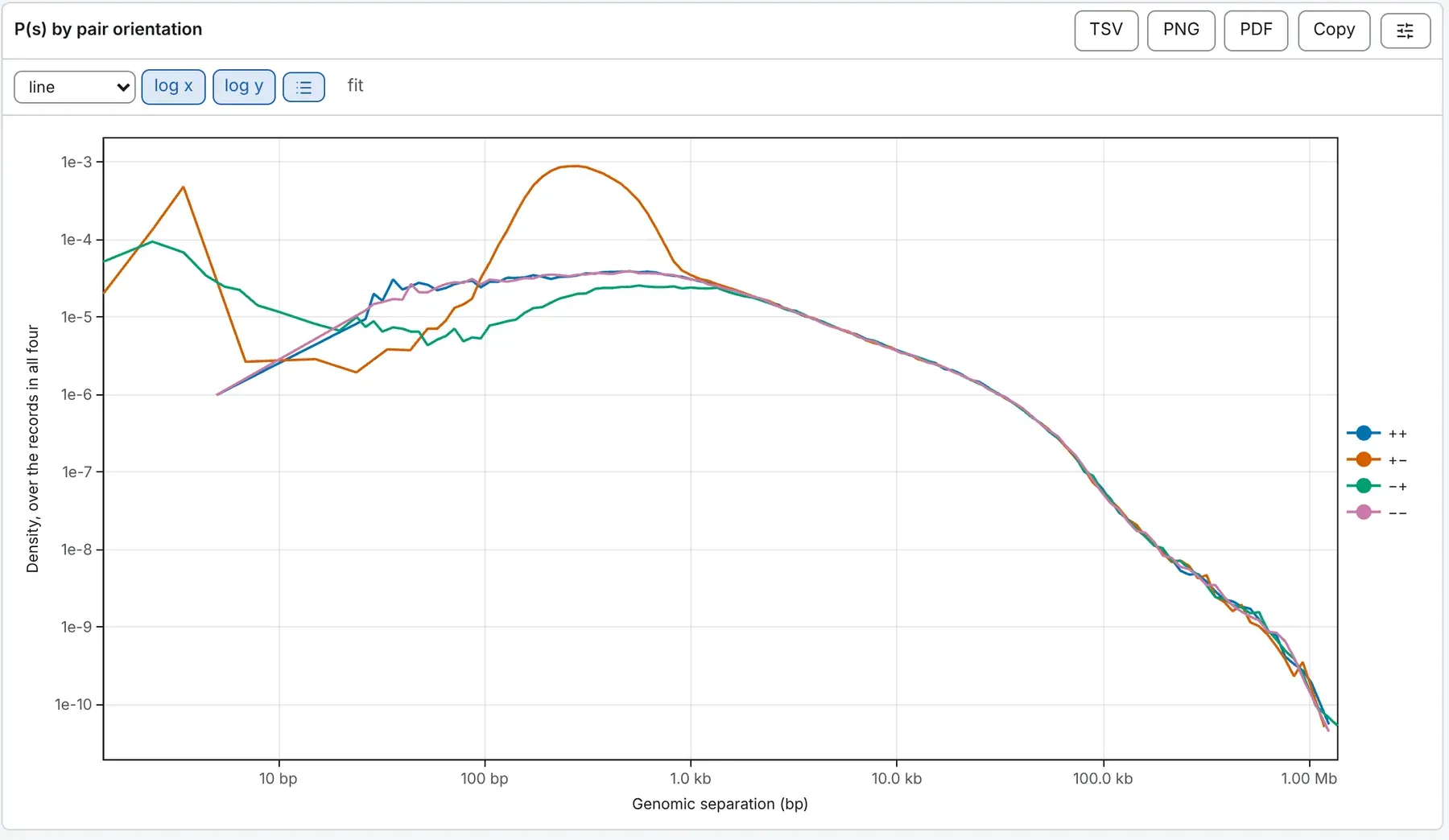
Section titled “The pairtools counts”- P(s) by pair orientation: the decay of the cis records in each orientation,
++,+-,-+and--, over one shared total. The four lie together at long range and part at short range, where self-circles, dangling ends and undigested fragments outnumber contacts. Where they meet is the shortest separation the library can be read at, usually shorter than one bin. The run’s note gives it by pairtools’ rule, past the last separation where one orientation strays more than 5 % from the mean of the four, and warns that chance strays in a sparse tail can push it further out than the curves suggest. - Pair types: how many records had each pairtools pair type, most common first.
- Cis and trans: the shares of the mapped, non-duplicate pairs that are cis and trans, and cis at least 1, 2, 4, 10, 20 and 40 kb apart, from 0 to 1, under pairtools’ own keys.
- pairtools stats: every entry
pairtools statswrites but its three long lists, in its keys and its spelling of a number, to lay beside a.statsfile.
The restriction fragments
Section titled “The restriction fragments”With a reference and an enzyme, both ends of every mapped, non-duplicate pair are placed in the fragments between the cuts, and the pair is classed by its ends’ fragments and strands, in order along the sequence:
| Class | The two ends |
|---|---|
| valid | anything not below: a contact |
| re-ligation | in two neighbouring fragments, +-: a fragment joined back to its neighbour, or a site left uncut |
| dangling | in one fragment, +-: a fragment that was never ligated |
| self-circle | in one fragment, -+: a fragment closed on itself |
| same-strand | in one fragment, ++ or -- |
| trans | on two sequences |
Four figures follow:
- Pair classes by orientation: the classes as bars stacked by the ends’ strands, then as a table with each class’s share of the pairs placed.
- Distance from a read to the next cut, in the direction the read points, as a histogram per strand. A dangling end’s two reads both give its fragment’s length, so the two strands lie together.
- Read ends per fragment: how many ends each fragment of the reference holds, in powers of two; the title counts the fragments that hold any.
- Coverage against sites: each bin’s raw contacts against the enzyme’s cuts in it, with Spearman’s ρ in the title. The mean line is drawn only where at least five bins share a number of cuts.
Things to know
Section titled “Things to know”- Each end is placed by its own strand’s cut: a
+end by the top strand’s cuts, a-end by the bottom strand’s. An enzyme that leaves an overhang cuts the two strands a few bases apart: a DpnII-read’s end lies 3 bp past the top strand’s cut. Placed by the top strand’s cuts alone, as one run ofpairtools restrictplaces every end, a DpnII library’s dangling ends would count as re-ligations. - Validation. On a yeast Hi-C contact list against DpnII sites, at 5 kb, every count matches
pairtools stats,pairtools restrictrun once per strand, andcooltools.coverage.
Documentation of chromosomix v0.20.0 · built from 40ec1ec · source