
3D models
A 3D model is a chain of beads, each a stretch of the genome placed in space. Dropped beside a map, it opens in a cell of its own, linked both ways to the map and its tracks (3D models beside the map); with no map, it opens over its beads’ genome and takes the screen. Each model is a row of the Annotations panel’s Structures card, whose Load a structure zone takes the formats below; the row’s eye shows and hides the model’s cell.
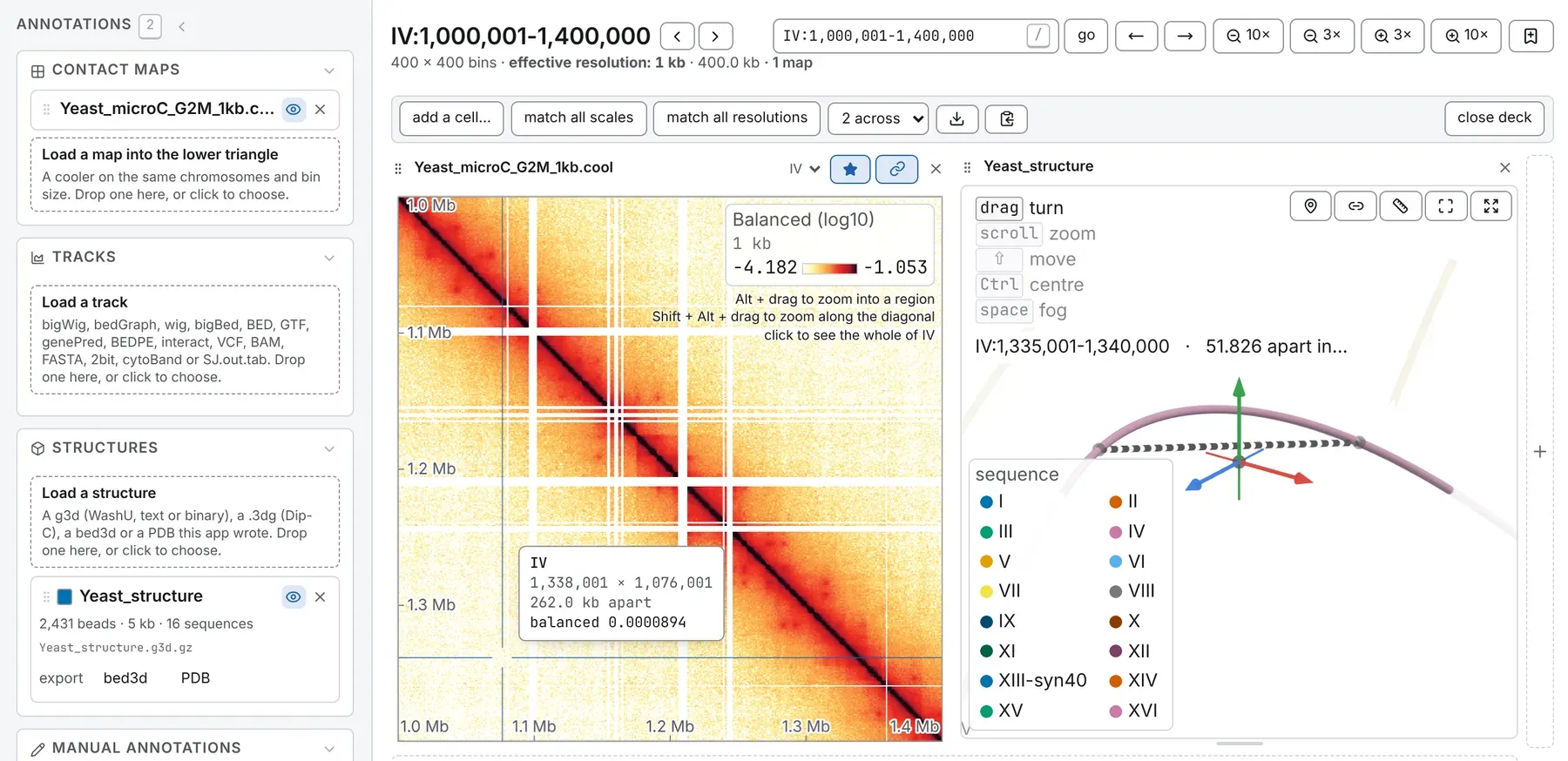
The formats
Section titled “The formats”| Format | Each row | What it is |
|---|---|---|
| g3d text | chrom start x y z [haplotype] |
WashU’s format: no end, no header, rows in any order |
.3dg |
the same, with the haplotype in the name, chr7(mat) |
Dip-C’s models |
| bed3d | chrom start end x y z [haplotype] |
the same with each bead’s end |
| binary g3d | — | what g3dtools load writes: a header and a block per resolution |
| PDB | atoms | a model chromosomix wrote, and only that (below) |
Text formats may be gzipped, and a file whose name says nothing is recognised by its content.
Ensembles and series of frames (FOF-CT, .cndb) are not read: a row holds one model.
- Haplotypes. The optional last column is
m,pors(ormaternal,paternal,shared), and a phased model draws two homologues per chromosome. Any other word is a category of its own. - Bead width. In a g3d it is taken as the commonest step between consecutive starts, and printed on the row: a model meant to be at 10 kb that reads 1.04 Mb was not read as you expected. A bed3d’s beads keep their own ends.
- A binary g3d opens at its finest resolution, its others named on the row. A version-1
container, from a
g3dtoolsolder than 0.2, is refused: rewrite it withg3dtools loadover the original text. - Beads with no place —
nan,NA,inf,.or nothing — are left out, the gap drawn as a dashed line. A file with no placed bead says so.
How a model is matched to the map
Section titled “How a model is matched to the map”A model meets a map in base pairs, by sequence name, matched as a track’s are (chr7 meets 7);
the row reports how many of its sequences the map has. Pointing at a map’s cell lights the beads at
its two loci, on both homologues of a phased model; pointing at a bead marks its place on every map
and track. Beads outside the maps’ window are ghosted, hidden or shown, as you choose. Changing the
map’s resolution moves no bead. Distances are in the model’s own units; nothing claims nanometres.
PDB files
Section titled “PDB files”chromosomix reads only the PDBs it writes, whose REMARK 250 lines place each bead on the genome;
of several MODELs, the first is read. A PDB from pastis or another solver is refused, and so is
one chromosomix wrote and PyMOL saved again, which drops the REMARK lines: write the coordinates
beside their bins as a bed3d, or open the file as chromosomix wrote it.
Saving a model
Section titled “Saving a model”A model’s row exports, after the word export, a bed3d, which reads back here and in
g3dtools, and a PDB for PyMOL or ChimeraX: a chain per sequence and haplotype, bonded along
the fibre but not across a gap. A model too big for a PDB’s columns — more than 99,999 beads, or a
chain of more than 9,999 — leaves as a bed3d only, and the button says why.
A model built by Model from the map leaves the same ways, and
chromosomix reconstruct3d --out writes both files. Model versus map
measures a model’s agreement with the map; Spatial tracks turns it into
tracks.
Documentation of chromosomix v0.20.0 · built from 40ec1ec · source