Interactions
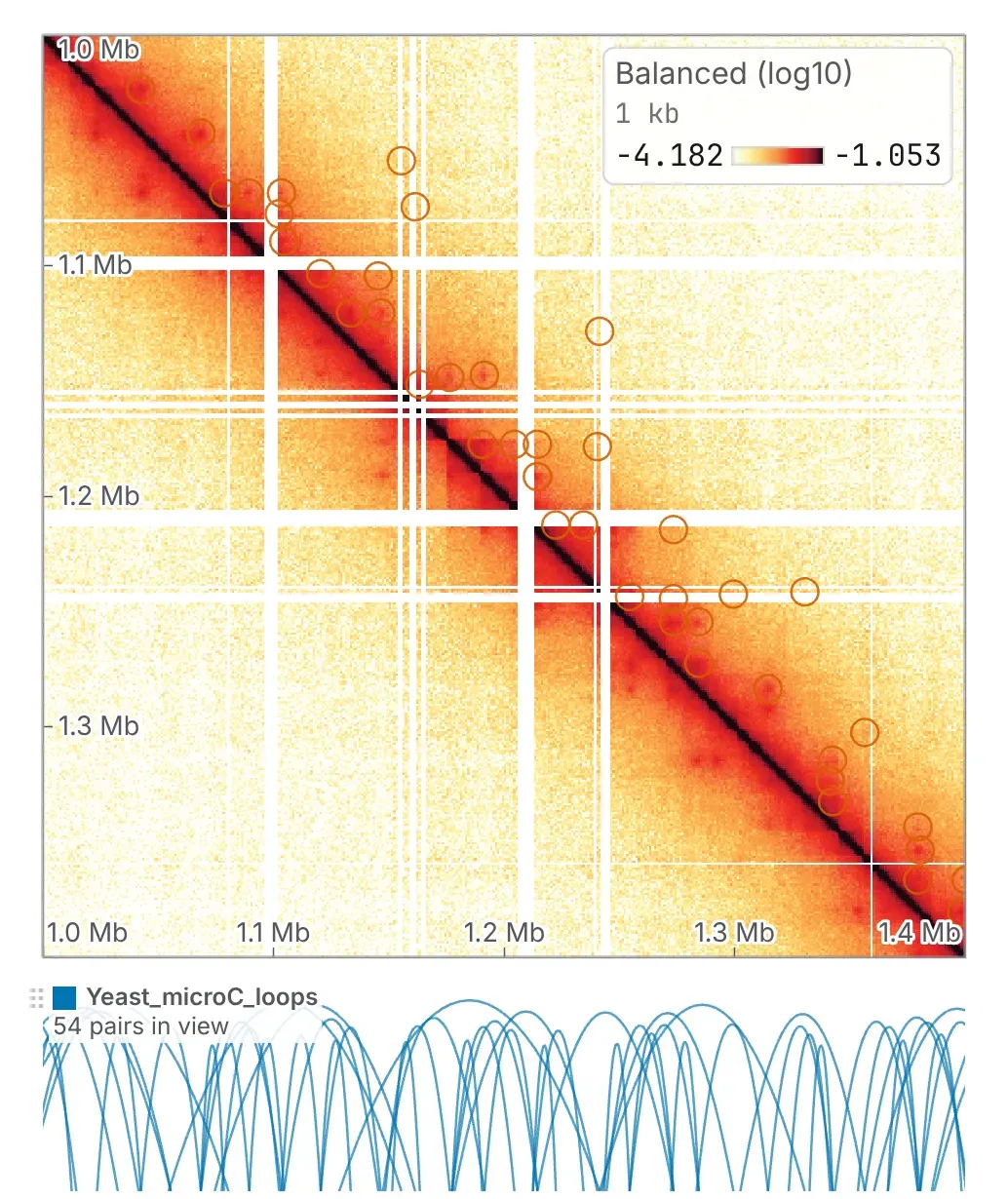
An interaction file lists pairs of places that touch, such as loop calls. Load one like any track — drop it on the map, or use the Tracks card’s Load a track (Opening files) — and it opens on the map, a ring round each pair.
The formats
Section titled “The formats”| Format | On disk | Read as |
|---|---|---|
| BEDPE | chrom1 start1 end1 chrom2 start2 end2 and optional columns after them, 0-based |
the six columns, or a headed table naming them, such as a loop caller’s .tsv; pairs across two sequences are kept, off the diagonal |
interact |
UCSC’s BED5+13: a span covering both ends, then each end’s sequence, start, end, name and strand | ranked, read out and exported by its value, not the 0–1000 score of UCSC’s shading, which stays on the pair’s card |
bigInteract |
the same rows in a bigBed | recognised by its schema |
longrange, longTabix |
a BED3 and a fourth column, chrom:start-end,score |
the score optional; the two mirrored lines of each interaction folded into one, the row saying how many |
A loop set saved as .txt or .tsv opens as pairs, recognised by its columns. A bgzipped
longTabix with its .tbi is read like any indexed text file
(Tracks and features). Sequence names are matched as a track’s are (chr1 against
1).
Rings and arcs
Section titled “Rings and arcs”A ring outlines the pixel it points at, never covering it. A set is drawn only on the maps it is placed on: dropped on a map’s middle, on this map while you drag, it is drawn there alone. In a deck, its row’s maps field has a mark per map, with every map, no map and on N of M (Maps side by side).
The row’s display switches between map overlay, the rings, and arcs (1D track) along any edges of the map. An arc’s height is the log of its span, so loops of 2 kb and 2 Mb show in one view, and a pair with one end off screen is still drawn. Flipping the lane hangs the arcs from its other side. In the 1D browser a set is always arcs.
Anchors, analyses and the command line
Section titled “Anchors, analyses and the command line”The row’s anchors export writes both ends of every pair as a BED, each place once.
The same files feed the analyses that pile up pairs, such as
Aggregate peak analysis, and the command line reads all four formats the same way
under --pairs and --features (Running a task). The Manual annotations card
writes and reads its arrowheads and rectangles as BEDPE
(Annotations and bookmarks).
Documentation of chromosomix v0.20.0 · built from 40ec1ec · source