
Model from the map
- In the app
- Analysis panel, under 3D tasks: Model from the map
- Command
chromosomix reconstruct3d- Reads
- A contact map
- Also known as
- 3D, structure, reconstruction, ShRec3D, negative binomial
Model from the map builds a 3D model of the open map: a chain of beads, one per bin, placed so that their distances explain the counts. Look at it beside the map, colour it by a track, or hold it against the map with Model versus map. A model is one reading of the map: the map fixes it only up to a mirror image, and two starts can settle in two optima.
Running it
Section titled “Running it”Open a contact map, then Model from the map, first on the 3D tasks card of the Analysis panel. It needs no model loaded, and on a deck it models the starred map.
sequences starts on what the map shows and takes a locus or comma-separated sequences; empty is the whole file. Each bin at the open resolution is one bead, so for a coarser model open the map at a coarser resolution. Time and memory grow with the square of the beads, with no ceiling: the line beside run gives the beads, the time per hundred refinement steps and the memory, and a browser that cannot give that much says so.
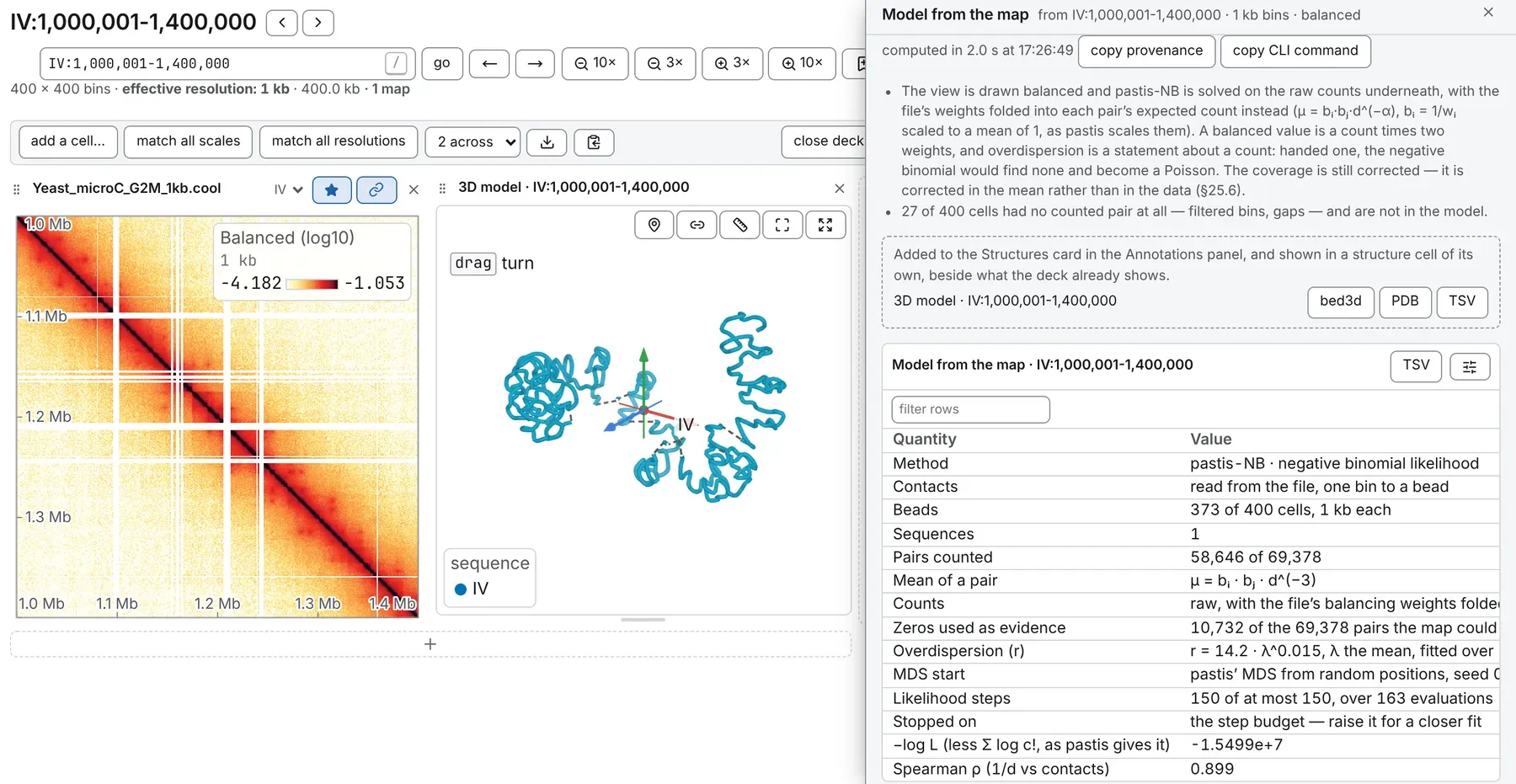
The model becomes a row of the Structures card in the Annotations panel, named after what was modelled, such as 3D model · chrIV, and opens in a structure cell of its own (3D models beside the map). A second run never replaces the first: it is numbered (2), then (3).
The same run from a shell:
chromosomix reconstruct3d <map> [--<parameter> <value> …] --out <dir>The shell writes a bed3d and a PDB beside the TSV files. pastis-NB’s fit runs on one thread unless you give --threads; the model is the same on any number.
Parameters
Section titled “Parameters”method changes the model, not just the speed. pastis-NB · a count is a count, the default, finds the model that makes the counts most probable under a negative binomial whose mean falls with distance: a zero count is weak evidence that two beads are far apart, not a distance to invent. ShRec3D · a count is a distance turns each count into a distance, d = c^(−1/α), fills in the pairs the map never counted, and refines a classical multidimensional scaling by SMACOF, weighted as weight pairs by says; it is faster. exponent α, 3 by default, is the fractal-globule value, the one Model versus map assumes; neither method fits it.
| Parameter | Takes | Default | What it does |
|---|---|---|---|
method--method <value> | nb or shrec3d | nb | The two published readings of a contact count, which give different models of the same map. nb — fits the model the counts are likeliest under, so a pair counted zero times is evidence rather than a distance to invent; shrec3d — faster, and what most published models were made with, but it has to invent a distance for every pair the map never counted. |
sequences--region <locus,…> | loci, comma-separated, display form | Every sequence of the file when left out. | A locus or comma-separated sequences, empty for the whole file, one bead per bin. |
exponent α--alpha <n> | a number, 0.5 to 6 | 3 | How steeply contacts fall off with distance: 3 is the fractal-globule value, 1 flattens the near diagonal, 6 stretches it. |
weight pairs by--weights <value> | contacts, sqrt or equal | contacts | How strongly a pair’s count holds its beads at the distance it implies. contacts — a pair seen a thousand times is a thousand times as sure as one seen once; sqrt — a weak pair is still heard on a deep map; equal — one vote each, which lets the far, weak pairs outvote the near diagonal. Read only under other settings of this task. |
seed--seed <n> | a seed, a whole number | 0 | Where pastis’ MDS places the beads before the fit; another seed can settle in another optimum. |
refinement steps--iterations <n> | a whole number, 0 to 2000 | 150 | How many steps refine the beads after the start, stopping earlier once a step stops buying anything. |
use balancing weights--no-balance | a switch | On wherever the file carries balancing weights; --no-balance reads the raw counts. | — |
What it writes
Section titled “What it writes”- intervals: a set of intervals: TSV, and BED (or BEDPE for pairs, or bed3d and PDB for a 3D model)
- table: a table: TSV
On the command line every file goes into --out as <file stem>.reconstruct3d.<output>.<ext>, and each TSV opens with # lines naming the build, the file and every parameter that produced it.
The model saves as a bed3d (chrom start end x y z, the 3D models format, which opens here again) and as a PDB for PyMOL and other molecular viewers, from the bed3d and PDB buttons of its row, the drawer or the shell. A PDB holds at most 99,999 beads, 9,999 to a chain; past that the PDB button is disabled and the shell writes the bed3d alone. A saved session keeps the recipe, not the coordinates: after a reload the row comes back detached, with recompute. Export the bed3d to keep the coordinates.
Reading the result
Section titled “Reading the result”The model
Section titled “The model”The model has no unit: it is centred and scaled to a root-mean-square radius of 1, so a distance read from it, in the cell or by the spatial tracks, is in model units, comparable within one model.
Two runs can come out as mirror images, which no rotation brings together: flip one with the mirror toggles on the frame row of the 3D structure card. compare with lays another model over this one and gives the beads matched and the RMSD; colouring by displacement shows where they differ. Under pastis-NB, run two or three values of seed: what every seed agrees on is what the map pins down. The same settings on the same map always give the same model.
The table
Section titled “The table”- Contacts, Beads and Pairs counted: where the counts came from, how many beads were placed of the bins read, and how many pairs the map counted. A bin with no counts, filtered or a gap, is left out, and a note says how many.
- Under pastis-NB: the law of a pair’s mean, whether balancing weights were folded into it, and how many zeros were used; the overdispersion
ragainst the mean, near the diagonal and at the farthest separation (a smallerris more overdispersed; none means the counts were Poisson and the fit is pastis-PM2); the MDS start and its seed; the steps; Stopped on; and−log L, pastis’ own objective. - Under ShRec3D: the distance law, the weighting, the steps taken and the final weighted stress.
- Spearman ρ (1/d vs contacts): how well the model’s distances rank the pairs the map counted; 1 orders every pair as the map does.
Check Stopped on first: the step budget — raise it for a closer fit means the fit was still improving when refinement steps ran out, so run it again with more. For the agreement sequence by sequence, run Model versus map on the new model.
A balanced map
Section titled “A balanced map”pastis-NB always reads the raw counts. Balancing weights go into each pair’s expected count, as in pastis, rather than being divided out, and a bin the balancer rejected is left out. The coverage is still corrected; a note says how. So on a balanced view it reads its counts from the file, not the block on screen, and the line beside run says so.
Compared with pastis
Section titled “Compared with pastis”The default method is pastis-NB as pastis runs it (Varoquaux, Noble & Vert 2023; GitHub 6888ac2, α = 3, zeros used), function for function: seed s places every bead where pastis’ random_state=s does. In the validation, on a yeast Micro-C map at 12.8 kb, the two give the same model from the same seed. One departure: a separation whose counts are not overdispersed beyond sampling noise is left out of the dispersion’s fit, and with fewer than three left the counts are read as Poisson; a real map clears that floor. There are no restarts: one model per seed, as in pastis.
ShRec3D (Lesne et al. 2014) departs from its paper in three ways: an uncounted pair takes the mean observed distance at its separation on its sequence, not a shortest path; the classical solution is refined by SMACOF; and that refinement is weighted by the counts.
Documentation of chromosomix v0.20.0 · built from 40ec1ec · source