
Base composition
- In the app
- Analysis panel, under 1D tasks: Base composition
- Command
chromosomix composition- Reads
- Tracks and interval files, with or without a contact map
- Also known as
- GC, GC skew, AT skew
Base composition turns a reference into tracks on fixed bins, to set beside the map or give to any task that reads a track: GC content, GC skew, AT skew and the cumulative GC skew.
Running it
Section titled “Running it”Load the reference as a FASTA or a .2bit (Reference sequences), open Base composition on the 1D tasks card of the Analysis panel, and choose it under reference. No map is needed: the bins are the open map’s, or 10 kb with no map open.
Each track ticked is a row of the Tracks card, marked *, named after the reference and any window: GC content · ref, GC skew · ref · 50,000 bp window.
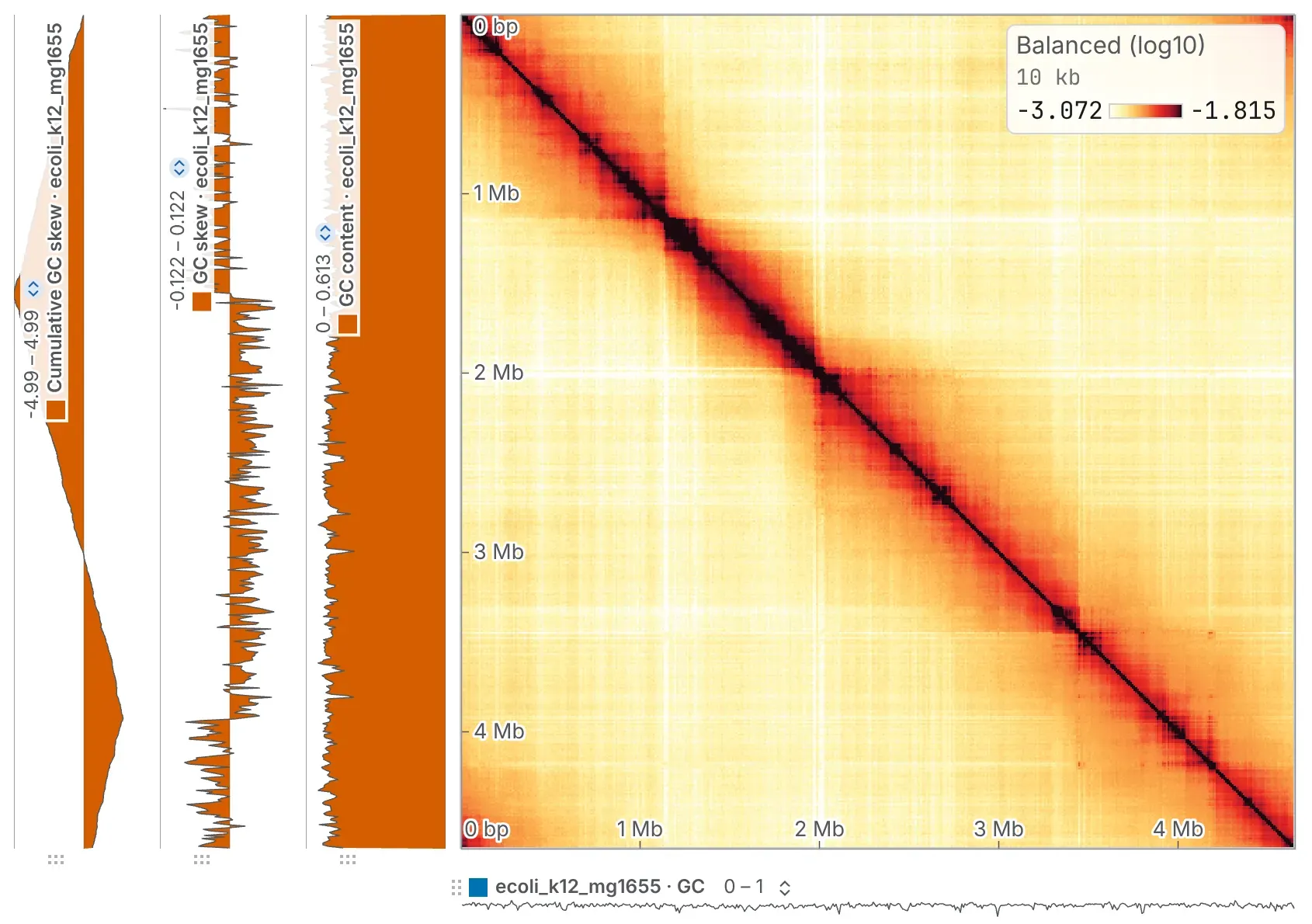
The same run from a shell:
chromosomix composition [<map>] --sequence <sequence.fa> [--<parameter> <value> …] --out <dir>Parameters
Section titled “Parameters”bin size follows the open map’s resolution until you type another. window smooths a noisy skew without changing its grid; it is rounded to an odd number of bins, and wraps round the junction of a circular sequence.
| Parameter | Takes | Default | What it does |
|---|---|---|---|
| General | |||
reference--sequence <file> | a file: a reference sequence | — | The FASTA to read, under the names of the sequences open. |
bin size--resolution <n> | a whole number, at least 1, in bp | Worked out from the map's bin size when left out; 10000 where there is no map. | The open map’s resolution unless changed, and 10 kb with no map open. |
window--window <n> | a whole number, at least 0, in bp | 0 | 0 reads each bin alone; wider reads that many bases centred on it. |
| Tracks | |||
GC content--gc / --no-gc | on or off | on | — |
GC skew--gcSkew / --no-gcSkew | on or off | on | (G − C) / (G + C), which changes sign at the origin and the terminus. |
AT skew--atSkew / --no-atSkew | on or off | on | (A − T) / (A + T). |
cumulative GC skew--cumulative / --no-cumulative | on or off | on | Its minimum is the origin and its maximum the terminus. |
What it writes
Section titled “What it writes”- profile: a value per bin: TSV, bedGraph and bigWig
On the command line every file goes into --out as <file stem>.composition.<output>.<ext>, and each TSV opens with # lines naming the build, the file and every parameter that produced it.
Reading the result
Section titled “Reading the result”- GC content is the share of G and C among the A, C, G and T of the bin, from 0 to 1. Any other letter, such as
N, is not counted, and a bin with none of the four is a gap. - GC skew is
(G − C) / (G + C), and AT skew(A − T) / (A + T), each from −1 to 1. On a bacterial chromosome the GC skew changes sign at the origin and again at the terminus. - Cumulative GC skew is the running sum of each bin’s own skew along the sequence. Its minimum is the origin and its maximum the terminus, wherever the assembly starts. It sums the bins’ own skews even when a window is set, and a gap adds nothing to it.
Origin and terminus makes that call for you. To test whether A is richer in GC than B, give the GC content track to Signal by group with a compartment call as the groups.
A sequence of the map that the reference lacks is a gap on every track, and one whose length differs is read from its start; a note names both.
Compared with bioframe and Biopython
Section titled “Compared with bioframe and Biopython”In the validation, GC content agrees with bioframe’s frac_gc, and the GC skew with Biopython’s GC_skew, to float32, except in a bin with neither G nor C, where Biopython writes 0 and chromosomix no value.
Documentation of chromosomix v0.20.0 · built from 40ec1ec · source