
Coverage and marginals
- In the app
- Analysis panel, under 2D tasks: Coverage and marginals
- Command
chromosomix coverage- Reads
- A contact map
- Also known as
- depth, marginal, balancing, weights
A bin’s coverage, or marginal, is every contact with an end in it: the track that tells a pale stretch of the map caused by the bin from one caused by the fold, and the check on a balanced file. Split into cis and trans, it says how much of each bin’s contact stays on its own sequence.
Running it
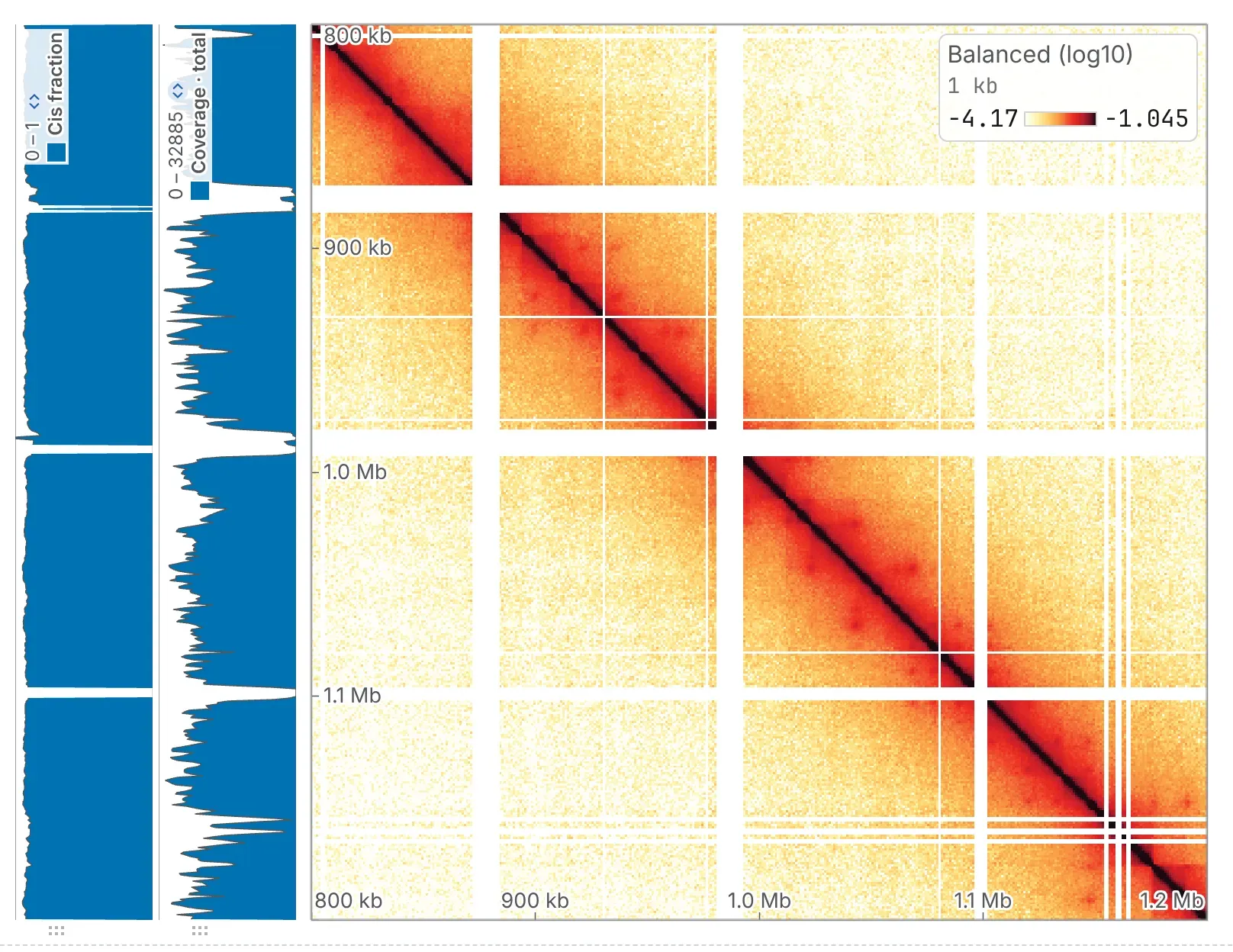
Section titled “Running it”Open a contact map, choose Coverage and marginals in the 2D tasks card of the Analysis panel, turn on the tracks you want — total coverage, on by default, and cis fraction, cis coverage and trans coverage — and press run.
Each track is a row of the Tracks card in the Annotations panel, marked *: Coverage · total,
Coverage · cis, Coverage · trans and Cis fraction, with its bigWig, bedGraph and TSV in the
row’s settings.
The same run from a shell:
chromosomix coverage <map> [--<parameter> <value> …] --out <dir>All four tracks, from the balanced counts:
chromosomix coverage sample.mcool::/resolutions/10000 --cis --trans --fraction --balance --out results/Parameters
Section titled “Parameters”Unlike every other task, coverage reads the raw counts unless you turn on use balancing weights
(--balance on the command line). Raw, the tracks are coverage as depth, which tells an artefact from
structure; balanced, they check the balancing.
| Parameter | Takes | Default | What it does |
|---|---|---|---|
total coverage--total / --no-total | on or off | on | Every contact touching the bin, and flat on a correctly balanced file. |
cis fraction--fraction / --no-fraction | on or off | off | Of the contacts a bin has, how many stay on its own sequence. |
cis coverage--cis / --no-cis | on or off | off | — |
trans coverage--trans / --no-trans | on or off | off | — |
use balancing weights--balance / --balance=false | on or off | off | Worth turning on to check the balancing itself: a balanced file should have a flat total, so one that is not is a file whose weights do not fit it. |
What it writes
Section titled “What it writes”- profile: a value per bin: TSV, bedGraph and bigWig
On the command line every file goes into --out as <file stem>.coverage.<output>.<ext>, and each TSV opens with # lines naming the build, the file and every parameter that produced it.
Reading the result
Section titled “Reading the result”Total coverage
Section titled “Total coverage”Each bin’s value is the number of contacts with an end in it, its contact with itself counted once. On the raw counts a dip is a bin every contact misses, and a pale stripe on the map over a dip is a property of the bin, not of the fold: look at the two together before calling a pale stretch a domain or a compartment. A bin with no contact reads 0, since the file stores only pixels that hold contacts. With use balancing weights on, a bin the balancer dropped is a gap, and the rest should be flat; a balanced total that is not flat is a file whose weights do not fit its counts.
Cis, trans and the cis fraction
Section titled “Cis, trans and the cis fraction”Cis coverage counts the contacts whose other end is on the bin’s own sequence, trans coverage those whose
other end is on another, and the two add up to the total. The cis fraction, cis / (cis + trans), from 0
to 1, is the share of a bin’s contacts that stays on its own sequence, and picks out stretches of the
assembly that behave unlike the rest. A bin with no contact has no cis fraction: a gap, not 0. One value
per sequence is Cis and trans per sequence.
What to watch for
Section titled “What to watch for”- The diagonal is counted once. cooltools’
coveragecounts a bin’s contact with itself twice; take each bin’s own diagonal pixel off cooltools’ value and the two agree, raw and balanced. - The map report counts differently: its contacts per bin count a contact within one bin twice, as Juicer does.
- Counts, not another score. On a map drawn from another score column, the marginals are of the counts, and the run’s note says so.
Documentation of chromosomix v0.20.0 · built from 40ec1ec · source