
Contact maps
Every format below opens as a contact map (Opening files), on its Chromosomes table, where you open a chromosome, a region or the whole genome (Reading a contact map).
| Format | What it is | How it is read |
|---|---|---|
.cool (or .h5, .hdf5) |
one cooler: a matrix at one bin size | by range, a block per view |
.mcool |
a cooler at each resolution of a ladder | by range, at the resolution you pick |
.hic |
Juicer’s format, versions 7, 8 and 9 | by range, at the resolution you pick |
.scool |
one cooler per cell, on shared bins | the cells you tick, summed |
| HiC-Pro | a .matrix and the _abs.bed beside it |
whole, once, then held in memory |
.pairs, .pairs.gz |
a list of contacts | binned once, at a bin size you choose |
Only maps whose bins are one fixed size are read (What is not opened).
Multi-resolution files (.mcool, .hic)
Section titled “Multi-resolution files (.mcool, .hic)”An .mcool opens a third of the way up its ladder from the finest, and zooming in never goes finer
than the rung you are on: pick the finest in the breadcrumb’s resolution picker when you want
it.
- Open one rung by its address:
sample.mcool::/resolutions/5000. - The whole genome and a chromosome’s first picture are read from a coarser rung.
- The + beside the picker sums a stored rung’s bins into a resolution the file does not store.
A .hic of version 7, 8 or 9 opens the same way (sample.hic::/resolutions/5000); its own
expected-value vectors and All chromosome are not read. An older .hic is refused: convert it
with hic2cool, or run Juicer Tools pre again.
Single-cell coolers (.scool)
Section titled “Single-cell coolers (.scool)”An .scool — in cooler.create_scool’s layout, or the older one of HiCMatrix and scHiCExplorer —
opens on its Cells table instead.
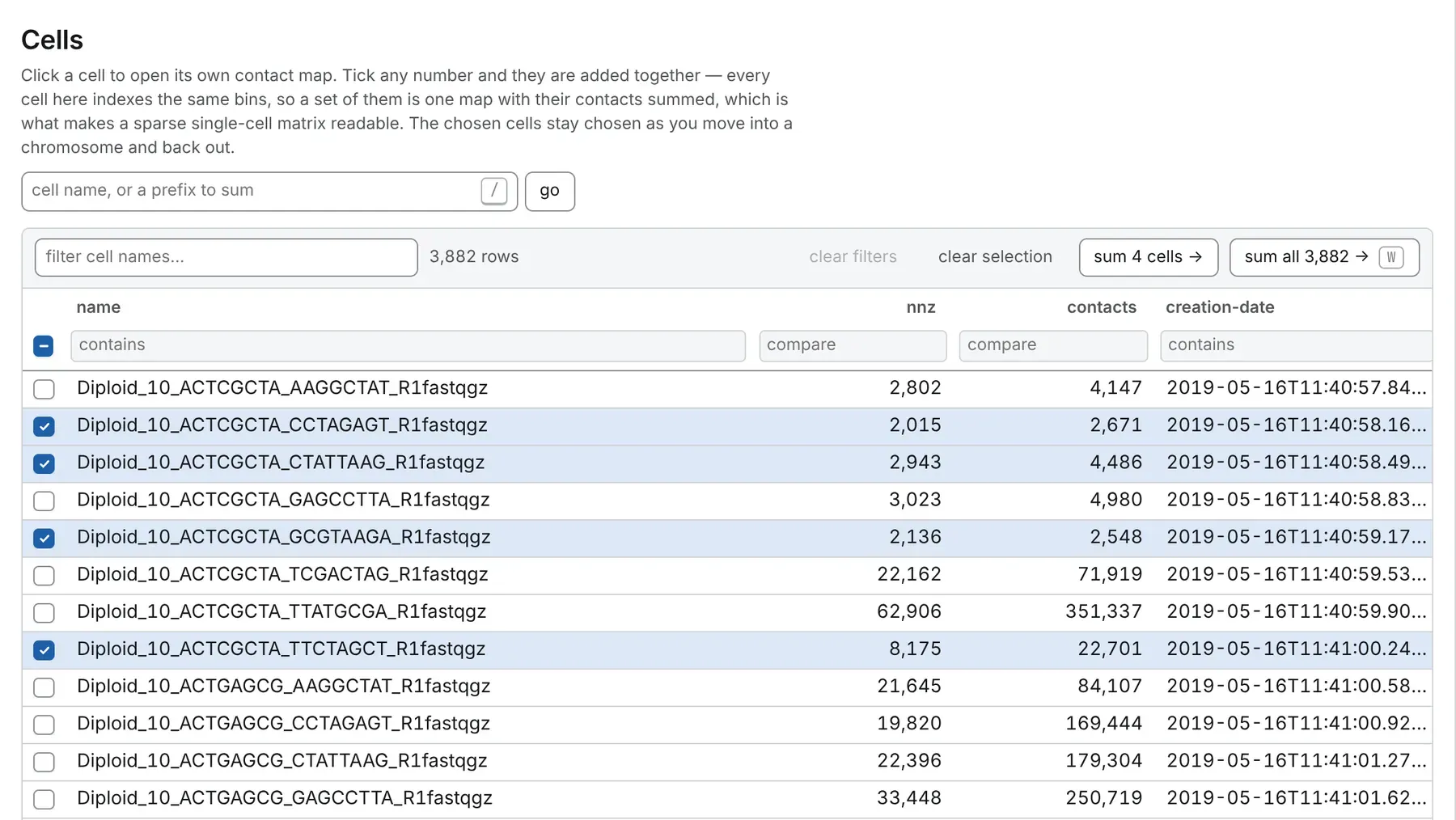
- Click a cell to open its own map, or open it by address:
file.scool::/cells/<name>. - Tick cells and press sum N cells → to sum them into one map, never side by side; sum all N → is the pseudo-bulk. The choice stays as you move in and out, and travels in a link.
From a server, an .scool first asks How should this single-cell file be read?:
download all … once, or read it in small pieces, far fewer bytes but minutes rather than
seconds. Per-cell contact QC measures each cell.
HiC-Pro matrices
Section titled “HiC-Pro matrices”A HiC-Pro map is two files from one run and resolution, gzipped or not: <prefix>_<res>_abs.bed,
its bins, and <prefix>_<res>.matrix (or _iced.matrix), its non-zero pixels, in any layout
(upper, lower, complete, asis). Open the two together, or the matrix is refused:
- drop or choose both, or pick the matrix from a connected folder with the bed beside it;
- open the matrix by address: the bed is found beside it, or in
raw/for a matrix iniced/; - or name the bed:
<address of the matrix>#bins=<address of the bed>.
The matrix is read at about 100 MB a second; over 200 MB, read all … shows the cost first, and
the read can be cancelled. About 100 million pixels is comfortable, and past about 250 million too
much for a browser tab: any small genome at any resolution, human down to about 250 kb. For a finer
map, convert the two files to a .cool once (HiC-Pro numbers its bins from 1):
cooler load -f coo --one-based sample_10000_abs.bed sample_10000.matrix sample_10000.coolThe .biases file is not read.
Pairs files (.pairs)
Section titled “Pairs files (.pairs)”A 4DN .pairs file, plain, gzipped or bgzipped, has no bin size: the first open asks how to bin it,
in the Bin dialog.
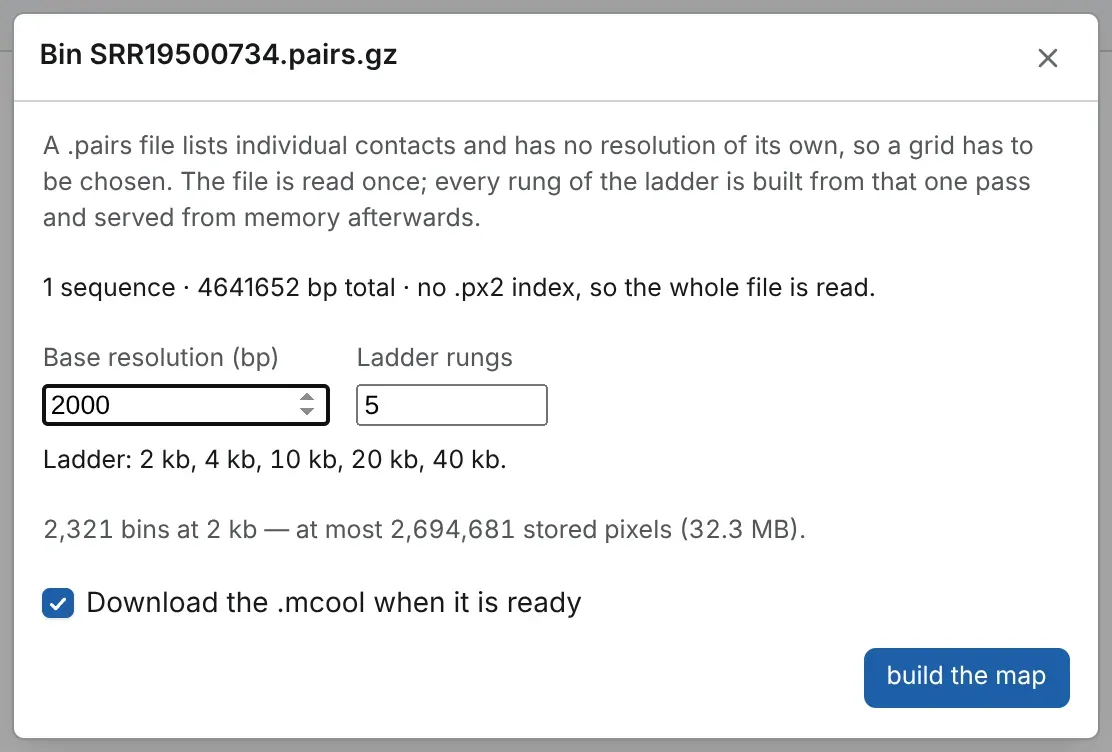
- Base resolution (bp) opens on a value suggested from the file, and snaps to a 1-2-5 series.
- Ladder rungs is how many resolutions to build, the base among them: five at first, up to thirteen. The lines under it price them, and warn when most bins would hold a single contact.
- Download the .mcool when it is ready, ticked at first, saves the result to open next time.
- build the map reads the file in one pass, with a progress bar and a cancel.
The first analysis you run reads the records once more.
- The header must start
## pairs formatand give each sequence’s length in a#chromsize:(or#samheader: @SQ) line, or the file is refused with the fix,pairtools header generate --chroms-path <chrom.sizes>. Columns follow the#columns:line, or the specification’s order. Positions are 1-based. - Nothing is filtered: duplicates (
DD) are counted as such and still binned, and mapping quality is not read. Filter withpairtools selectorpairtools dedupand import the result. - An incomplete file, bgzipped and cut off part-way, is drawn from the records that arrived and flagged Incomplete file, naming the sequences with nothing on their diagonal.
- A slow import can be a
.pairs.gzwritten in very small blocks, which inflates several times more slowly than one inbgzip’s own 64 KiB blocks. Re-block it once:
bgzip -d < sample.pairs.gz | bgzip > sample.reblocked.pairs.gzPairs statistics and the .stats file
Section titled “Pairs statistics and the .stats file”The import also counts what pairtools stats counts, on the General panel’s Pairs statistics
card: records, mapped, one side, unmapped, duplicates (only with a pair_type
column), cis, trans, library size and strands meet, where the four read orientations
converge — each as a count and the share pairtools and MultiQC give it, with charts. save .stats
writes them in pairtools’ format, for MultiQC or pairtools stats --merge. The command line writes
the same file:
chromosomix stats sample.pairs.gz --out qc/Pairs QC reads the same records with restriction fragments added.
Balancing weights
Section titled “Balancing weights”The score box of the Aesthetics panel’s Map card sets what each cell holds: counts to begin with, balanced where the file carries weights, or any extra column of a cooler’s pixel table. VC, VC √ and ICE, computed from the counts on screen, are offered for every map.
balanced is each raw count times its two bins’ weights, matching cooler’s balanced matrix cell for cell. A bin the balancer dropped has no weight: its row and column are transparent, absent rather than empty. Without weights, balanced is not offered, and a link asking for it opens on counts.
| File | Its weights |
|---|---|
.cool |
the weight column cooler balance writes into its bins table |
.mcool |
each rung’s own; cooler zoomify --balance balances every rung |
.hic |
the best normalisation vector at the open resolution — SCALE, then KR with its INTER_KR and GW_KR variants, then the coverage ones — named on the normalisation row of the General panel’s File card, or none at this resolution |
.scool |
the one weight column all its cells share, if any, applied to their sum |
| HiC-Pro | none: open the iced/ matrix for normalised counts |
What is not opened
Section titled “What is not opened”- Bins of different sizes: a fragment-level cooler or HiC-Pro map (
GENOME_FRAGMENT); a.hic’s fragment resolutions are not offered. Bin the contacts at a fixed size withcooler cload pairs. - A gzipped or zipped cooler: decompress it first. A
.pairs.gzor.matrix.gzis read compressed. - HDF5 that is not a cooler, an
.mcoolor an.scool. - A BAM: it is drawn as reads (Tracks and features), never as a map.
What to do about each refusal: When a file will not open.
Documentation of chromosomix v0.20.0 · built from 40ec1ec · source