
Origin and terminus
- In the app
- Analysis panel, under 1D tasks: Origin and terminus
- Command
chromosomix oriter- Reads
- Tracks and interval files, with or without a contact map
- Also known as
- ori, ter, replication, GC skew, dif
A bacterial map is read from its origin of replication, which nothing in a .cool records. Origin and terminus places both ends of replication from the sequence, checks them against parS, matS and the coverage, and declares the origin for the rest of the app. Run it first on any bacterial genome.
Running it
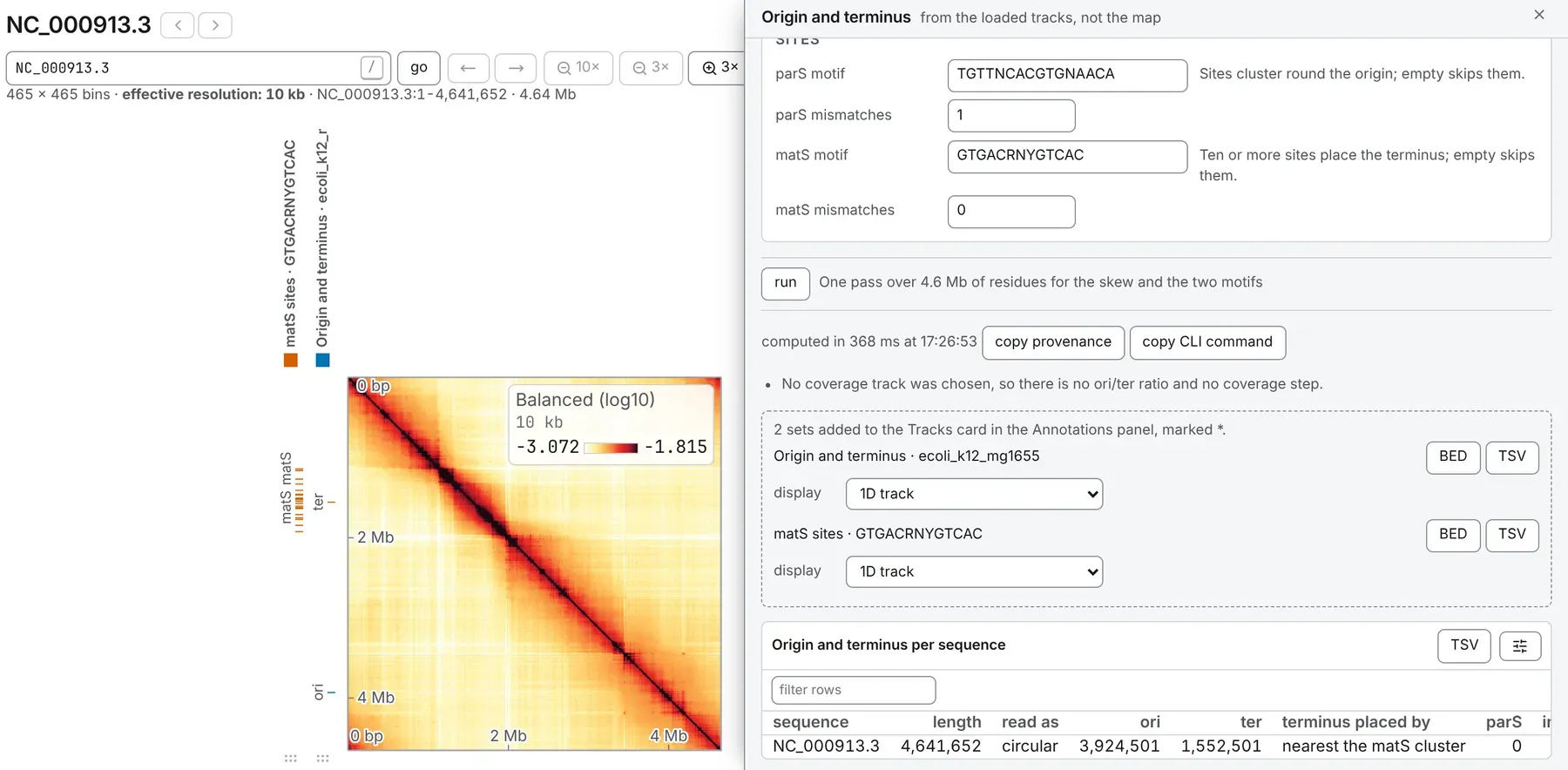
Section titled “Running it”Load the genome’s FASTA (Reference sequences), open Origin and terminus on the 1D tasks card of the Analysis panel, and choose it under reference. Run it beside the map, so the loci land on the map’s sequences. For the coverage step, choose a raw Hi-C coverage track under coverage, such as Coverage and marginals makes; it starts on Do not use coverage.
Check that the chromosome is ticked circular in the Chromosomes table (the app ticks one it finds circular); read as linear, its origin at the first base is split between its two ends, and the run says so.
It makes a track of the ori and ter loci of each sequence, Origin and terminus · genome; a track for each set of parS or matS sites found, such as parS sites · TGTTNCACGTGNAACA; with a coverage track and a map, the smoothed coverage, its name ending spline fit; the table Origin and terminus per sequence; and the origin, written into the origin column of the Chromosomes table unless you typed one there yourself.
The same run from a shell, where --circular declares a circular sequence (chromosomix circular on the map lists them); pass the origin it reports to later runs, such as interarm, as --origin:
chromosomix oriter [<map>] --sequence <sequence.fa> [--<parameter> <value> …] --out <dir>Parameters
Section titled “Parameters”The defaults are the published ones and suit most bacteria. matS is searched exactly: at one mismatch it turns up dozens of times by chance in a genome with no MatP. Empty a motif to skip its step. spline knots shapes the smoothed coverage.
| Parameter | Takes | Default | What it does |
|---|---|---|---|
| General | |||
reference--sequence <file> | a file: a reference sequence | — | The FASTA to read the skew and the sites from. |
sequences--sequences <name,…> | sequence names, comma-separated | Every sequence of the file when left out. | — |
coverage--coverage <file> | a file: a signal track; optional | not used | Raw Hi-C coverage: breaks a tie, and gives the ori/ter ratio. |
| GC skew | |||
skew window--window <n> | a whole number, at least 100, in bp | 5000 | — |
skew step--step <n> | a whole number, at least 10, in bp | 1000 | — |
| Sites | |||
parS motif--parS <text> | text | TGTTNCACGTGNAACA | Sites cluster round the origin; empty skips them. |
parS mismatches--parSMismatches <n> | a whole number, 0 to 4 | 1 | — |
matS motif--matS <text> | text | GTGACRNYGTCAC | Ten or more sites place the terminus; empty skips them. |
matS mismatches--matSMismatches <n> | a whole number, 0 to 4 | 0 | — |
| Coverage | |||
spline knots--knots <n> | a whole number, 4 to 40 | 10 | Of the cubic spline the coverage is smoothed with. Read only under other settings of this task. |
What it writes
Section titled “What it writes”- intervals: a set of intervals: TSV, and BED (or BEDPE for pairs, or bed3d and PDB for a 3D model)
- table: a table: TSV
- profile: a value per bin: TSV, bedGraph and bigWig
On the command line every file goes into --out as <file stem>.oriter.<output>.<ext>, and each TSV opens with # lines naming the build, the file and every parameter that produced it.
Reading the result
Section titled “Reading the result”How a call is made
Section titled “How a call is made”The cumulative GC skew has its minimum at one end of replication and its maximum at the other. The terminus is chosen as Bacchus chooses it (Lamy-Besnier et al. 2023), each step used only where the one before says nothing:
- matS: with ten or more sites, the terminus is the candidate nearer their cluster.
- parS: with any sites, the terminus is the candidate farther from their cluster.
- coverage: the terminus is the candidate with the lower smoothed coverage.
- Otherwise, the skew’s convention: the minimum is the origin.
The table
Section titled “The table”For each sequence: its length, whether it was read as circular or linear, ori and ter (the centres of the two loci, 1-based), terminus placed by (the step that decided), the parS and matS sites found and how many parS sit in their cluster, and ori/ter: the highest smoothed coverage over the lowest, copies of the origin per copy of the terminus. It is above 1 in a growing culture, and higher the faster the culture was replicating.
What to watch for
Section titled “What to watch for”- A terminus placed by matS, parS or coverage at the skew’s minimum, where the skew alone would put the origin, is named in a note: check the assembly, or the motifs.
- The loci are a skew window wide, the precision the skew has.
- A sequence shorter than four skew windows, or missing from the reference, is not placed; the note names it.
- A FASTA over 64 MB is declined: the call reads each sequence whole.
- The origin is what inter-arm alignment and the map’s ori button read. The task’s own is replaced by its next run, which is how you try other sites; one you typed is never overwritten.
Documentation of chromosomix v0.20.0 · built from 40ec1ec · source