
Reference sequences
Beside a map, a FASTA or a .2bit draws a lane of GC content; in the 1D browser, the bases once
each has a pixel, and the six reading frames on request
(The genome browser). With no map, it opens the 1D browser over its
genome. It feeds the sequence tasks, such as Find a motif,
Base composition and Restriction sites, and
colours a BAM’s mismatches.
A FASTA (.fa, .fasta, .fna or .fas) under 64 MB is read whole. A larger one needs its
.fai, beside it or named with #index=<address>, to be read by range; without one it is read
whole up to 300 MB, and refused above with the command that indexes it:
samtools faidx genome.faRead by range, a sequence’s GC lane draws nothing over a window wider than 4 Mb (GC under 4 Mb, letters at base resolution — zoom in), Origin and terminus declines it, and a BAM’s mismatches are coloured only over the stretch the sequence lane last drew.
A gzipped or bgzipped FASTA is always read whole, and refused past 300 MB, since its .gzi index is
not read: decompress and index it, or use a .2bit.
A .2bit is read by range, with an indexed FASTA’s limits, and holds its own index: one file, a
quarter of the FASTA’s size. Gaps are read as runs of N; soft-masking is not shown. Refused: a
version-1 .2bit, made for files over 4 GB (convert it with twoBitToFa and faToTwoBit); one
declaring more than 100,000 sequences; and a truncated one.
One genome, many names
Section titled “One genome, many names”Wherever a name is asked for — a track, a second map, a 3D model, the locus box — the file’s own spelling is tried first, then these rules:
| Rule | Example |
|---|---|
| another case | Chr1 = chr1 |
| the same accession, undecorated | ref|NC_001133| = NC_001133 |
the chr prefix |
chr1 = chrom1 = chromosome_1 = 1 |
| leading zeros | 01 = 1 |
| Roman numerals | chrXII = 12 |
| an organelle spelled another way | chrM = MT = MtDNA = NC_012920.1 |
| the accession | NC_000001.11 = chr1; chrUn_GL000220v1 = GL000220.1 |
| another version of the accession | NC_000001.10 ≈ NC_000001.11 — offered, and flagged |
They never quietly match two different sequences:
- The whole list decides.
Xis chromosome ten in a list withIXandXI(budding yeast), and the sex chromosome where the numerals stop atV(C. elegans) or where chromosomes are numbered both ways (a host with a yeast spike-in). Bare numbers in a list longer than any genome’s chromosomes, such as an assembler’s contigs, match only as spelled. - Not equated: an arm and its chromosome (
2Lis not2); a patch or one parent’s copy and the chromosome (_random,_alt,_fix,_hap1,_maternal); a linkage group (LG) and a chromosome number. A name that follows no convention matches only exactly. - Lengths check the match. Sequences matched across conventions with different lengths, as two assembly versions have, are flagged: Matched across two naming conventions, but the sequences are different lengths….
A map in a deck notes under its heading how it read a name (“chrIV” read as “IV”, by the chr prefix). On a track’s row, No sequence in this file matches the map (0 of 16) means every convention failed: the file is likely about another genome.
Circular sequences
Section titled “Circular sequences”A bacterial chromosome, a plasmid or a mitochondrion arrives linear, the contacts joining its ends in the map’s far corner, until it is declared circular.
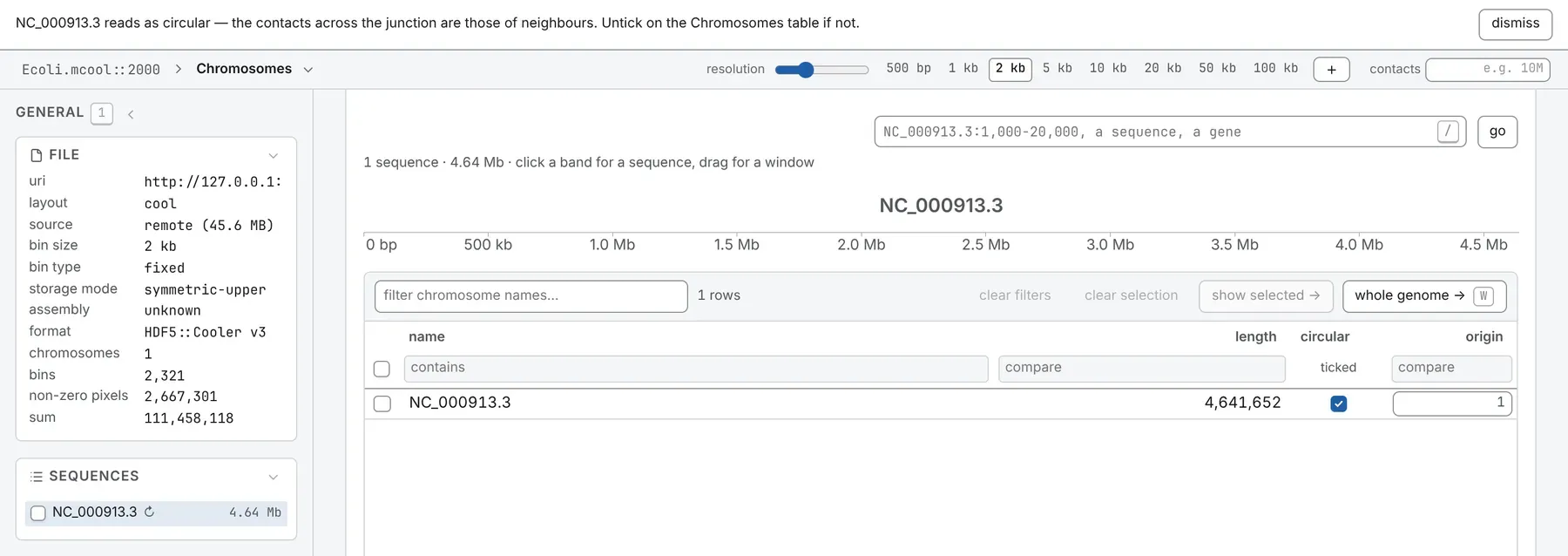
Tick it in the circular column of the Chromosomes table, or of a genome opened from a FASTA or tracks. Its origin, beside the tick, is its first base until you type a 1-based position or let Origin and terminus place it; the task never overwrites a position you typed.
On a file’s first open, its 50 longest sequences with at least 50 bins are scored on their contacts across the two ends against the diagonal’s at the same separation: about 1 for a circle, 0 for a line. At 0.2 or more a sequence is ticked, with a banner saying where to untick it and its score in the tick’s tooltip; an untick stays. A small circle at a coarse resolution may be missed: tick it yourself.
Once ticked:
- a window can cross the junction:
chrom:2,900,000-100,000on a 3 Mb circle is the 200 kb across it; - the map offers ori, the whole circle with its origin in the middle, and arms, observed over expected along both arms rather than the diagonal alone (Reading a contact map);
- the analyses measure separation the short way round: P(s), insulation, the directionality index, the HiC score, the scalogram, compartments and the tasks that read from the origin. Chromosight and the observed-over-expected map do not.
Declarations are kept with the file and in a saved workspace, not in a link. On the command line,
chromosomix circular <map> runs the same test, and --circular <name> and --origin <name:pos>
declare them for a run (Command line).
Documentation of chromosomix v0.20.0 · built from 40ec1ec · source