Spatial tracks
- In the app
- Analysis panel, under 3D tasks: Spatial tracks
- Command
chromosomix spatialtracks- Reads
- A contact map
- Also known as
- 3D, structure, radial position, compaction
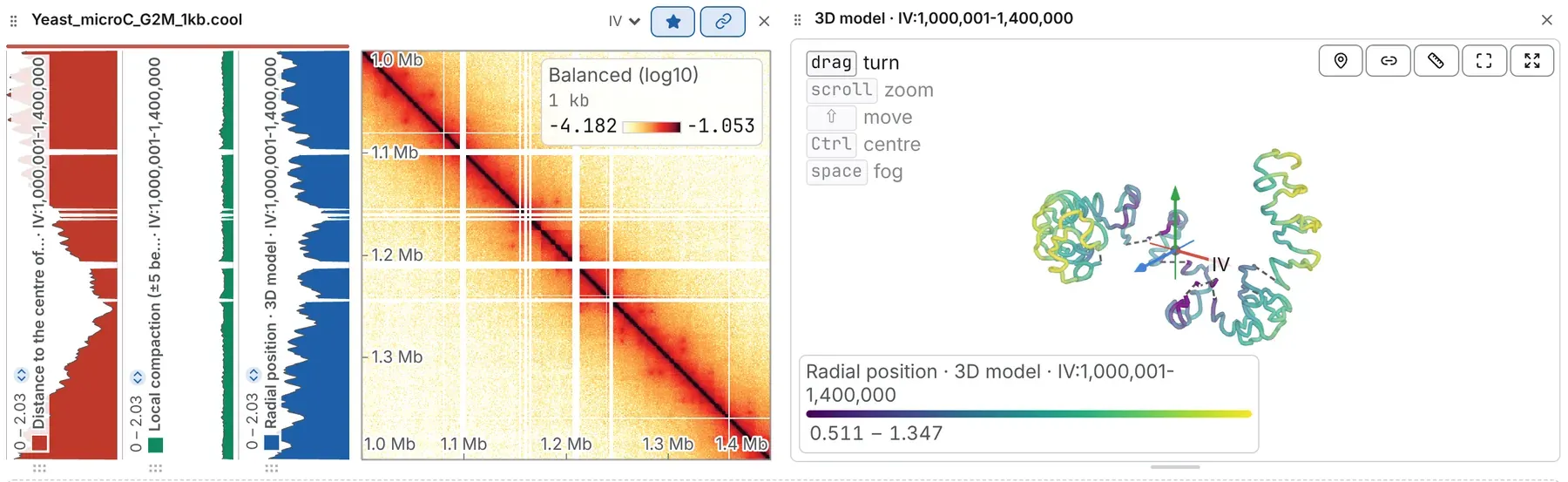
Spatial tracks turns a 3D model into tracks on the map’s bins — radial position, distance to a locus and local compaction — to read beside the map, colour the model by, or give to any 1D task.
Running it
Section titled “Running it”Open a contact map and put a model on the Structures card; until then the task is greyed on the 3D tasks card of the Analysis panel. Choose the model under structure. For the distance track, give a locus under distance to: type it, or press pick on map and Shift-drag over the stretch on the map. Left empty, only the other two tracks are made.
The tracks are lanes beside the map, rows of the Tracks card in the Annotations panel, marked * and named after the model: Radial position, Local compaction with its window, as in Local compaction (±5 beads), and Distance to the centre of the locus. A phased model has tracks for each haplotype.
The same run from a shell:
chromosomix spatialtracks <map> --features <structure.bed3d> --structure <structure.bed3d> --locus <locus> [--<parameter> <value> …] --out <dir>Parameters
Section titled “Parameters”A small compaction window follows the chain bead by bead; a wider one averages a longer stretch. distance to takes a point or a window, measured from the centre of the beads it covers.
| Parameter | Takes | Default | What it does |
|---|---|---|---|
structure--structure <file> | a file: a feature set | — | The model to read: a row of the Structures card. |
distance to--locus <locus> | a locus, display form | None. | A locus to measure every bead’s distance from — the spatial virtual 4C — and empty leaves the other two tracks alone. |
compaction window--window <n> | a whole number, 1 to 100 | 5 | How many beads either side a bead is compared with, for the local compaction track. |
What it writes
Section titled “What it writes”- profile: a value per bin: TSV, bedGraph and bigWig
On the command line every file goes into --out as <file stem>.spatialtracks.<output>.<ext>, and each TSV opens with # lines naming the build, the file and every parameter that produced it.
Reading the result
Section titled “Reading the result”Every value is a distance in the model’s own units, a root-mean-square radius of 1 for a model made by Model from the map, so the tracks compare positions along one model, not between models. Each bin takes the mean over the beads whose middles fall in it; a bin no bead falls in is a gap.
- Radial position: the distance from the centre of mass of every bead the model and the map share, which on a model of one chromosome is that chromosome’s own centre. High is far out.
- Distance to the centre of a locus, the spatial virtual 4C: low is close. Set it beside the map’s 4C profile from the same anchor: a model that honours the map puts near the anchor what the map counted often with it. With no bead at the locus, the track is not made, and a note says so.
- Local compaction: each bead’s mean distance to its neighbours along the chain, within the window. Small is compact; a bead with no neighbour on its sequence has no value.
To colour the model by a track, choose it under colour by on the 3D structure card.
Documentation of chromosomix v0.20.0 · built from 40ec1ec · source