
When a file will not open
When chromosomix cannot open a file, it says why and what to do. A contact map is replaced by a page naming the problem, with advice, open another file and, where it can help, try again. A track stays on the Tracks card, the reason in red under its name.
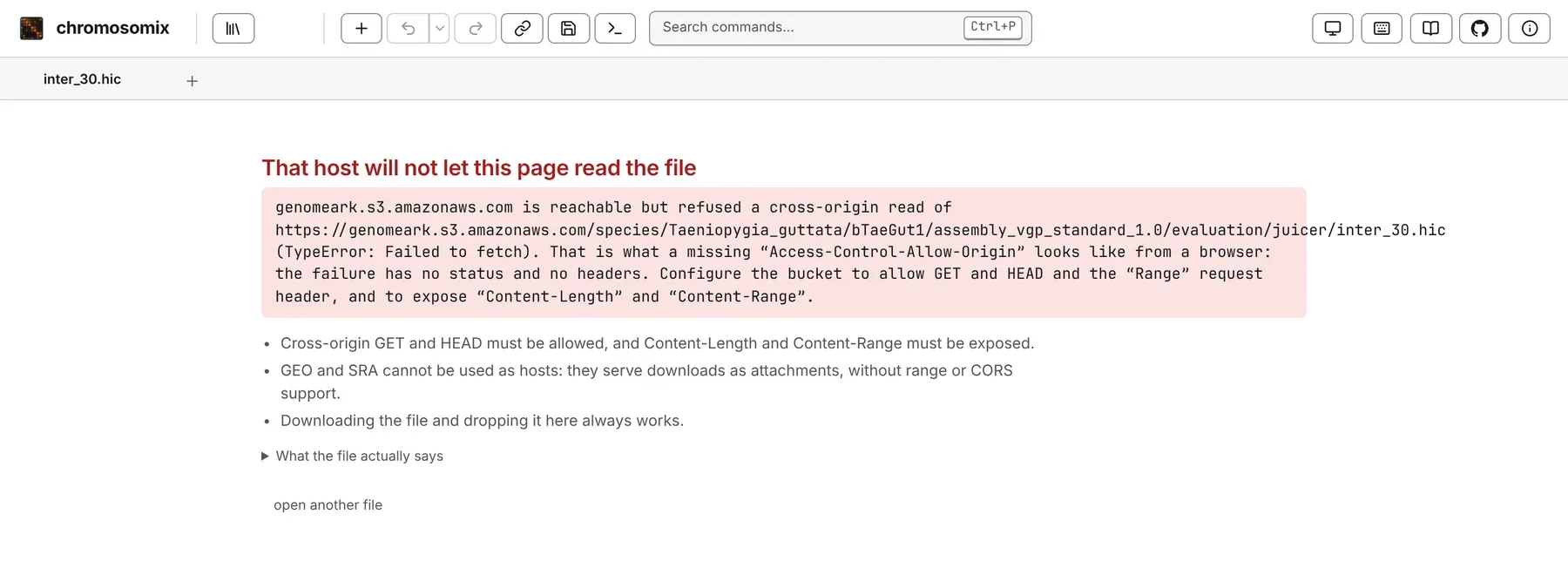
Two fixes work for almost any file on a server: download it and drop it on the window, or have its host serve it as Hosting your data describes.
The host will not serve the file
Section titled “The host will not serve the file”That host will not let this page read the file. The host refused a cross-origin read (CORS), or
the request. It must allow GET and HEAD from other sites, accept the Range header, and expose
Content-Length and Content-Range; serves ranges but does not expose its size means those two
are not exposed.
That host does not serve byte ranges. Host the file on object storage, or download it and drop it. GEO and SRA download links serve neither ranges nor CORS.
That host is compressing the file in transit. A contact map of up to 128 MB as sent is then downloaded whole and opens anyway; a larger one is refused as Too much to download for this operation. Object storage serves files uncompressed by default; GitHub Pages always compresses. The desktop app asks hosts not to compress, and does not meet this.
The host would not give this file. 404 or 410: no file at that address. 401 or 403: a file this page may not read — private, at a wrong address, or moved. A public file must be readable by anyone. For a private bucket, connect it with its key (connect a bucket…, Opening files); a refusal after that lists what to check. A presigned, signed or SAS link refused after working yesterday has expired: ask for a fresh one.
A Google file answers 401 or 403. A private Drive file or Cloud Storage object needs a Google sign-in: the refusal offers sign in, or sign in again after an hour. Refused while signed in, the file is not shared with that account, or the day’s Drive quota is spent.
A bucket that opens files but will not list. … does not allow anonymous listing: the bucket
grants s3:GetObject but not s3:ListBucket. Its files still open by address; to browse it, the
owner grants s3:ListBucket, or you connect it with a key that has it.
A UCSC hub or a store that cannot be read. Its host must allow cross-origin reads; UCSC’s own servers do not (Data stores).
The file is not what its name says
Section titled “The file is not what its name says”This is not an HDF5 file. The file may be a compressed cooler (a .cool.gz or a zip: decompress
it), a download cut short, or a web page saved under the file’s name.
HDF5, but not a contact map. Not a cooler, an .mcool or an .scool. Check you picked the
right file; h5ls lists what it holds.
Text, but not a table this viewer reads. Tables are tab- or space-separated, one feature per
line. A headed table needs a sequence, a start and an end as its first three columns, or columns
named chrom1, start1, end1, chrom2, start2 and end2.
This file does not match the format. The message names where the file breaks its format, often ending the file is truncated, corrupt, or not the format its first bytes claim. Download it again.
Dimmed in a folder. The Files panel’s tooltip says why:
| Name | Why, and what to do |
|---|---|
.csv |
comma-separated: the tables read here are tab- or space-separated |
.bz2, .xz, .zst |
a compression that cannot be inflated here: recompress with gzip, or bgzip to index it |
.cram, .crai |
CRAM needs its exact reference, which is not fetched: convert with samtools view -b |
.gzi |
not used: a compressed FASTA is read whole |
hub.txt, genomes.txt, trackDb.txt |
a UCSC hub, which opens as a store from its hub.txt |
.tbi, .bai, .csi, .px2 |
an index, which comes with the file it indexes |
A contact map that cannot be read
Section titled “A contact map that cannot be read”Variable-bin file. A fragment-level cooler or HiC-Pro map is refused, and a .hic’s fragment
resolutions are not offered: bin the contacts at a fixed size with cooler cload pairs.
This is a version … .hic file. Only versions 7, 8 and 9 are read: convert it with hic2cool, or
run Juicer Tools pre again.
This is half of a contact map. A HiC-Pro .matrix needs its _abs.bed: drop both, pick the
matrix from a connected folder holding both, or name the bed with <matrix>#bins=<bed>.
A .pairs with a header problem. The import needs a first line ## pairs format (give a
headerless contact list one with pairtools header generate, or bin it with cooler cload pairs),
#chromsize: lines (pairtools header generate --chroms-path <chrom.sizes> adds them), and two
chromosome and two position columns, as its #columns: line names them.
Incomplete file. A bgzipped .pairs cut off part-way is drawn from the records that arrived; a
complete download fixes it.
Selection too large to draw. Show whole sequences rather than bins, narrow the range, or pick a coarser resolution. Where the limit is an estimate for this machine, load anyway reads it regardless, at the risk of the tab running out of memory.
Unknown sequence, That range does not parse. A locus is a sequence, or sequence:start-end,
1-based and inclusive as in IGV and samtools, with or without thousands separators and k, M or
G, its end not before its start and both inside the sequence. Only a sequence declared circular
takes a window across its end (Reference sequences).
A .pairs file, a remote .scool and a HiC-Pro matrix over 200 MB ask a question before opening
rather than refuse (Contact maps).
An index that is missing or unusable
Section titled “An index that is missing or unusable”A BAM with no index is read by searching the sorted file (reads located by search), unless its
host will not say its length: publish its index beside it, or name it with
#index=<address of the .bai>. A BAM not sorted by coordinate — sorted by name, or a Hi-C
pipeline’s alignment file in read-pair order — is refused. Sort and index it, or, for Hi-C, open the
.pairs or the contact map instead:
samtools sort -o sorted.bam reads.bamsamtools index sorted.bamA FASTA over 300 MB with no index is refused: index it with samtools faidx genome.fa and keep
the .fai beside it. A gzipped FASTA past 300 MB is refused whatever sits beside it: decompress and
index it, or use a .2bit.
A missing .tbi or .px2, or a damaged .tbi, costs only time: the file is read whole.
Too large to read whole
Section titled “Too large to read whole”- Text past about half a gigabyte, such as a whole-genome human VCF: split it by chromosome (Tracks and features).
- A bigBed past a million intervals is cut off at the millionth, and says so.
- A HiC-Pro matrix past about 250 million pixels: convert it with
cooler load -f coo --one-based <abs.bed> <matrix> out.cooland open that. - A whole download past about 2 GB, such as a remote
.scool: download the file yourself and drop it.
A track that draws nothing
Section titled “A track that draws nothing”- No sequence in this file matches the map (0 of 16): every naming convention failed, so the file is likely about another genome.
- 10 of 16 sequences matched; nothing is drawn on …: the file covers part of the map. Check it was made against the same assembly.
- Matched across two naming conventions, but the sequences are different lengths: two assembly versions look like this; the coordinates land, but may not mean the same place.
- A lane that says zoom in will not draw at this width: GC under 4 Mb, letters at base resolution — zoom in for a sequence read by range, 12.4 MB of reads — zoom in for a BAM, zoom in to see reads for a lane too short or too far out for its reads.
A 3D model that is refused
Section titled “A 3D model that is refused”- A version-1 g3d: rewrite it with
g3dtools loadover the original text. - A PDB says where each bead is in space and not where it is on the genome: a solver’s PDB. Write its coordinates beside their bins as a bed3d.
- The lines that said where each one is on the genome are gone: a chromosomix PDB saved again by PyMOL. Open the file chromosomix wrote, or its bed3d.
A file that was open yesterday
Section titled “A file that was open yesterday”- A local file does not reopen from a link or a restored tab on its own: where the browser kept permission, press allow access to the file; otherwise drop it again.
- A connected folder whose permission lapsed shows reconnect in the Files panel.
- A folder listing that stops at Only the first 1,000 entries of … are listed: open a sub-folder, or open the file by its address.
In other copies of chromosomix
Section titled “In other copies of chromosomix”- The single HTML file opens local files only; use the website for remote files and stores.
- The desktop app cannot sign in to Google; public Drive links still open there.
- A copy built by somebody else without a Google client id or a Dropbox app key offers no sign-in, and its Connect dialog says why: ask its maintainer, or use the website.
Something else
Section titled “Something else”Something went wrong heads any other failure. Try again; if it persists, report it on the project’s GitHub issues with the message under the heading.
Documentation of chromosomix v0.20.0 · built from 40ec1ec · source